
SE Ranking vs Mangools isn’t just a question of which SEO tool is “better.” It’s a question of how serious you are about SEO and how far you plan to take it.
From the outside, both platforms look affordable, user-friendly, and ideal for beginners. But once you’re publishing consistently, tracking keywords, and relying on data instead of guesswork, those surface similarities fade fast. Choose the wrong tool at this stage and you don’t just slow down — you create workflow friction, stitch together extra tools, and end up compensating with manual work.
This comparison exists to prevent exactly that. Below, we’ll break down how SE Ranking and Mangools behave in real-world usage for affiliate sites, content scaling, competitor analysis, and long-term keyword strategy. You’ll walk away with a clear sense of which platform fits your goals, your workflow, and the way you actually use SEO tools in 2025.
Two SEO Tools Built for Very Different Use Cases
At a glance, SE Ranking and Mangools seem similar. Both promise keyword research, rank tracking, competitor insights, and clean interfaces. That’s where most shallow comparisons stop — and that’s where people make the wrong decision.
Mangools is designed to simplify SEO as much as possible. Its tools are intentionally lightweight, visually clean, and focused on making keyword research and SERP analysis easy to understand. It’s built for speed, clarity, and approachability.
SE Ranking is designed to manage SEO as a system. Instead of focusing on individual tasks, it brings keyword research, rank tracking, site audits, backlink monitoring, and reporting into one platform that’s meant to be used continuously as your site grows.
Neither approach is wrong — but they are not interchangeable.
Who These Tools Are Designed For
If you’re comparing SE Ranking and Mangools, you’re probably already using SEO tools regularly and want something that feels reliable rather than experimental. This comparison isn’t aimed at people casually checking keyword volumes once a month. It’s for site owners, bloggers, freelancers, and small teams who care about rankings and want a tool that supports consistent growth instead of creating friction.
At this stage, the wrong tool doesn’t just feel inconvenient — it affects how confidently you choose keywords, how often you track performance, and how much manual work you end up doing outside the platform. That’s why the differences between SE Ranking and Mangools matter more than they first appear.
Where the Real Differences Start to Matter
On the surface, both tools offer keyword research, rank tracking, and basic competitive insights. In practice, they feel very different once you start using them week after week.
Mangools is built around speed and clarity. It’s the kind of tool you open, get answers quickly, and close again. SE Ranking is built for ongoing SEO management — tracking progress over time, auditing changes, and adjusting strategy as your site grows.
Neither approach is inherently better. What matters is whether you want a lightweight research companion or a platform that becomes part of your daily SEO workflow.
Why Choosing the Wrong Tool Becomes a Problem Later
Many users pick an SEO tool based on price or interface alone. That usually works in the short term, but problems show up once content output increases or competition becomes tougher.
Tools designed for simplicity often struggle with scale. Limits appear faster, data depth becomes a concern, and users end up patching gaps with extra software. Tools designed for growth may feel heavier at first, but they reduce long-term friction by keeping everything in one place.
This comparison focuses on those long-term trade-offs rather than surface-level features, so you don’t end up switching tools again six months from now.
Keyword Research & SERP Analysis: How SE Ranking and Mangools Actually Feel in Daily Use
Keyword research is where most people first notice the gap between SE Ranking and Mangools. Both tools are capable, but they’re optimized for very different working styles, and that difference becomes obvious after just a few sessions.
Mangools approaches keyword research with one clear priority: speed and clarity. Its KWFinder tool presents keyword data in a way that’s immediately understandable. You enter a query, and within seconds you see search volume, keyword difficulty, CPC, and a well-curated list of related terms. The interface avoids noise, which makes it easy to spot long-tail opportunities without second-guessing what the data means.
For content creators and bloggers, this is where Mangools shines. You can move from idea to outline quickly, especially when your strategy revolves around publishing frequently and targeting lower-to-medium competition keywords. KWFinder doesn’t overwhelm you with metrics you won’t use, and that restraint is intentional.
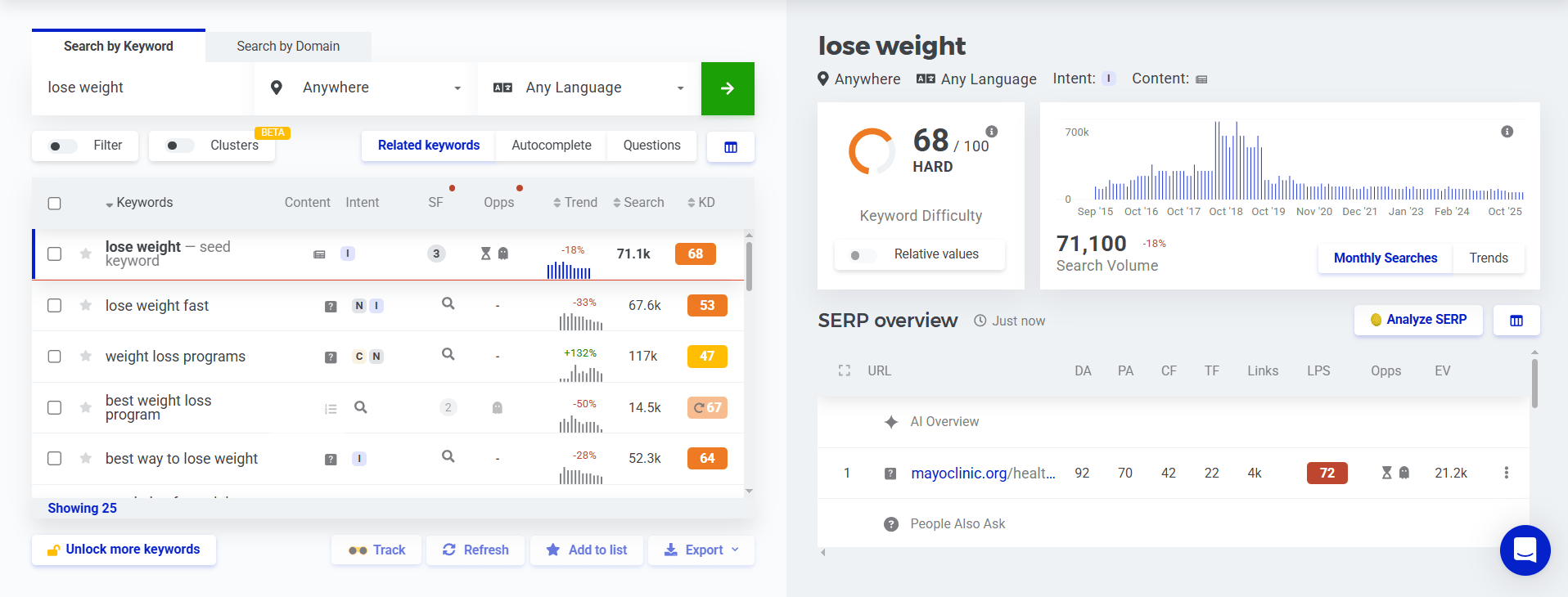
Mangools KWFinder Keyword Overview
For a broader look at how different platforms handle keyword discovery and difficulty scoring, the Best Keyword Research Tools for 2025 comparison highlights where tools like SE Ranking and Mangools sit in the wider SEO landscape.
SE Ranking takes a more analytical approach. Keyword research here is not just about finding ideas, but about understanding how competitive a keyword really is and how it behaves over time. In addition to volume and difficulty, SE Ranking provides historical data, broader keyword grouping options, and stronger competitor context. This makes it easier to evaluate whether a keyword is worth pursuing now or later.
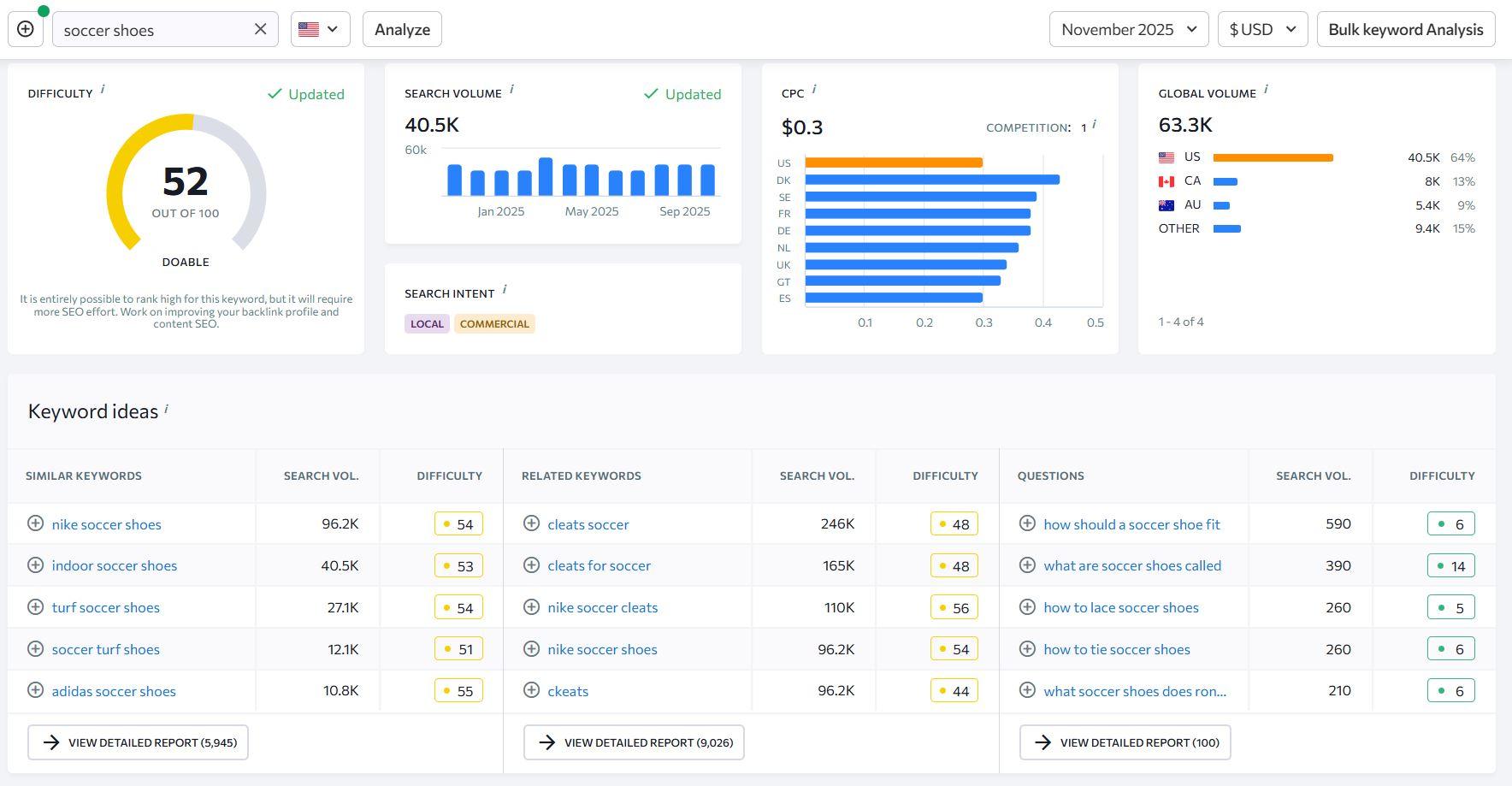
SE Ranking keyword research dashboard
Where Mangools helps you move fast, SE Ranking helps you make fewer mistakes. That difference matters once you’re targeting keywords that require time and resources to rank for.
SERP Analysis: Visual Simplicity vs Competitive Context
Mangools’ SERPChecker is designed to answer one question quickly: Can I realistically rank for this keyword? It presents the top-ranking pages alongside key metrics like authority and backlink strength in a visually clean layout. For newer sites or niche projects, this is often enough to decide whether to proceed with a topic.
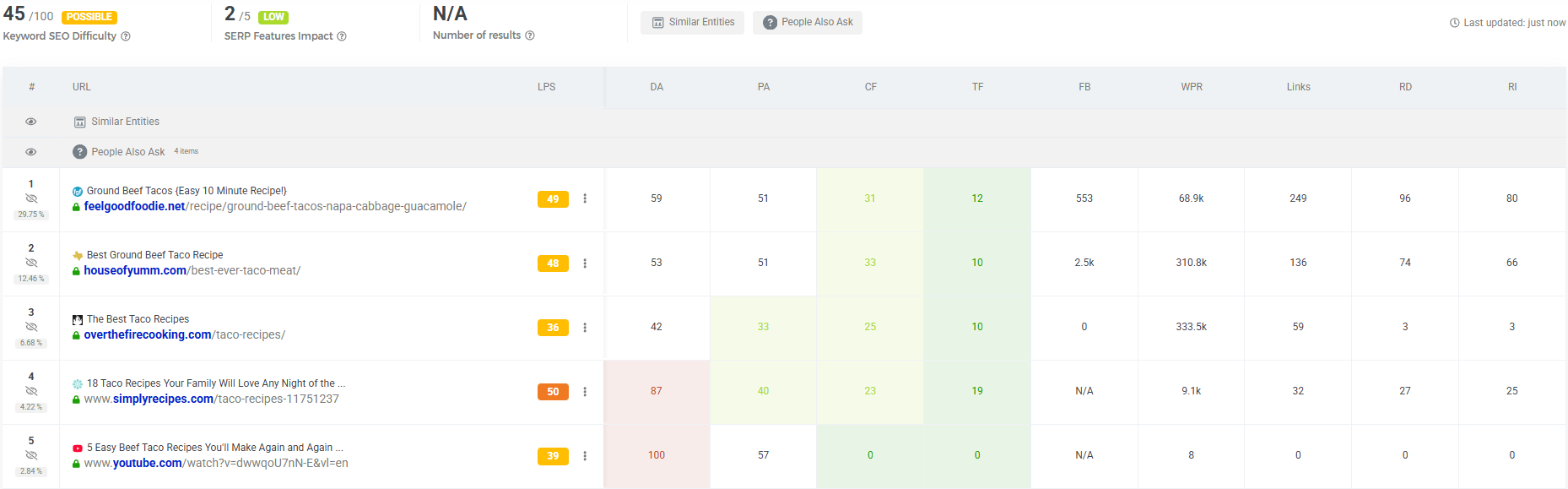
Mangools SERPChecker results view dashboard
SE Ranking’s SERP analysis goes further by adding context over time. Instead of focusing on a single snapshot, it allows you to observe ranking volatility, competitor overlap, and historical positioning. This is particularly useful in competitive niches where SERPs shift frequently and short-term observations can be misleading.
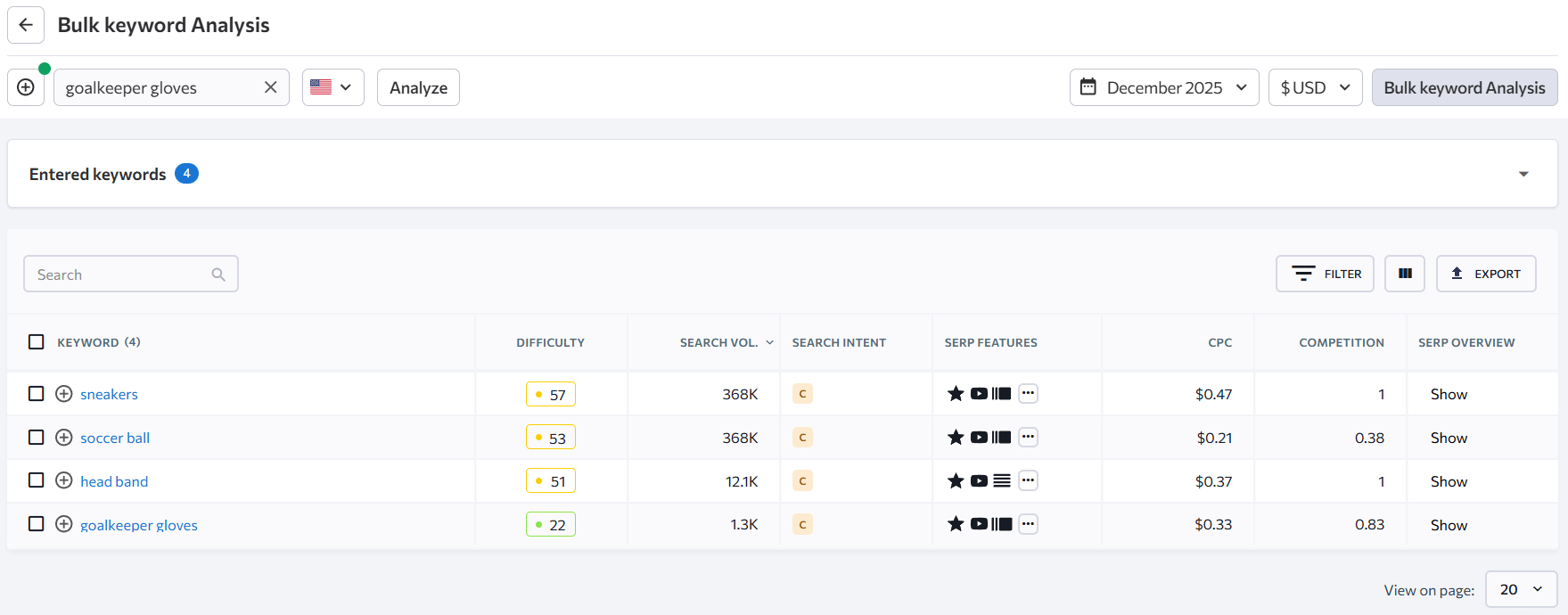
SE Ranking SERP analysis dashboard
If your goal is to publish efficiently, Mangools gives you fast validation. If your goal is to plan content strategically and avoid wasted effort, SE Ranking offers more depth.
Keyword Difficulty: Ease of Use vs Strategic Accuracy
Mangools’ keyword difficulty score is easy to interpret and works well for long-tail targeting. It’s especially helpful for users who want a clear “yes or no” signal before writing content. This simplicity reduces hesitation and speeds up decision-making.
SE Ranking’s difficulty scoring is more nuanced. It incorporates competitive signals that reflect real ranking conditions, which can sometimes make keywords appear harder than they do in Mangools. While this can feel conservative, it often results in more realistic expectations — especially when scaling content across multiple categories.
The difference isn’t about right or wrong. It’s about whether you prefer confidence through simplicity or confidence through caution.
SE Ranking’s more analytical approach to keyword evaluation becomes clearer when viewed alongside its full feature set, which is covered in detail in the SE Ranking Review.
Which Tool Works Better for Keyword Research in Practice?
If your workflow is content-heavy and speed-driven, Mangools feels lighter and more enjoyable. It helps you identify opportunities quickly and move straight into publishing.
If your workflow is growth-driven and competitive, SE Ranking provides more reassurance that the keywords you choose are worth the effort. It reduces guesswork and supports planning at scale.
This distinction sets the tone for the rest of the comparison, because the same pattern appears again in rank tracking, audits, and overall SEO management.
Rank Tracking & Performance Monitoring in Real Use
Rank tracking is where the difference between SE Ranking and Mangools becomes much harder to ignore. Both tools can show you where your keywords rank, but they are built with very different assumptions about how often you track performance and how much detail you need.
Mangools treats rank tracking as a supporting feature rather than the core of the platform. SE Ranking treats it as a central pillar. That distinction shapes the entire experience.
Mangools: Clean, Lightweight Tracking That Prioritizes Trends
Mangools’ rank tracking lives inside SERPWatcher, and its goal is clarity rather than depth. Instead of overwhelming you with charts and filters, it focuses on a visibility score that shows whether your tracked keywords are improving or declining over time. For many users, this is enough to answer the most important question: Is my SEO working?
The interface is easy to understand, even if you’ve never used a rank tracker before. You add keywords, select a location, and monitor progress without touching advanced settings. This makes SERPWatcher particularly appealing for bloggers, niche site owners, and creators who don’t want to micromanage rankings.
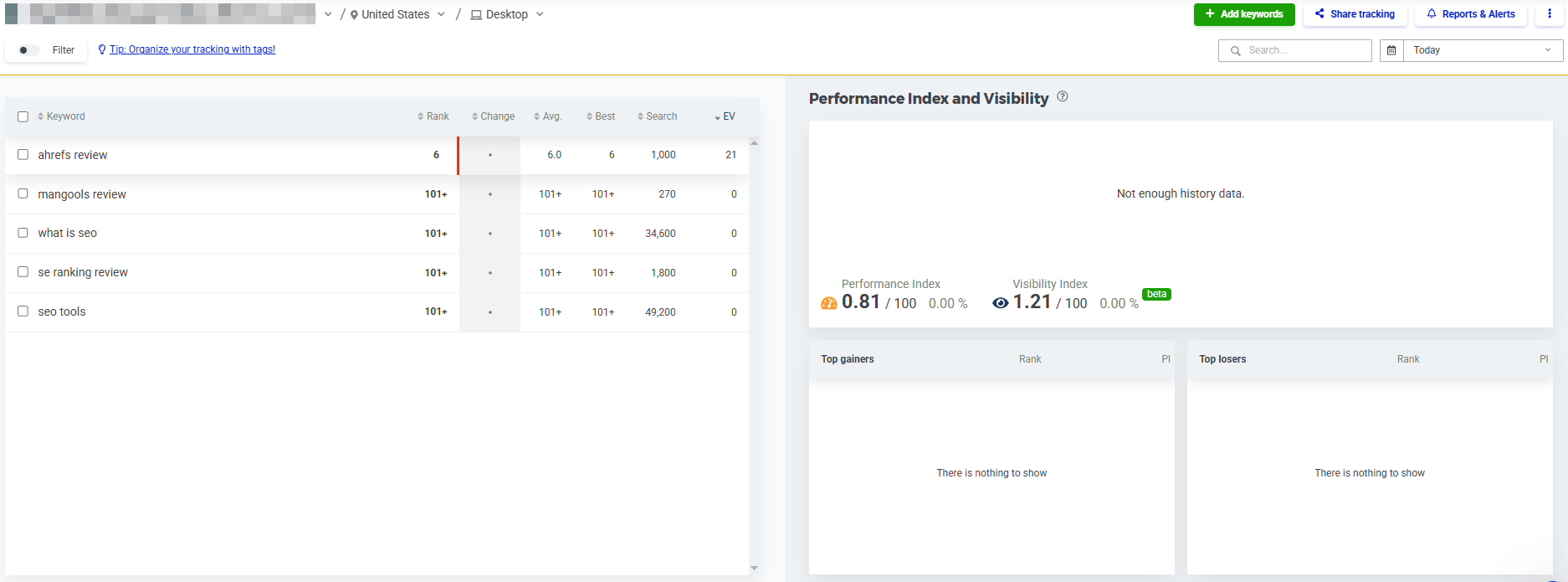
Mangools SERPWatcher overview
Instead of relying on a single visibility score, SE Ranking lets you break performance down by keyword groups, pages, competitors, and SERP features. This is especially valuable when rankings fluctuate due to algorithm updates or competitive pressure, because you can isolate patterns rather than guessing.
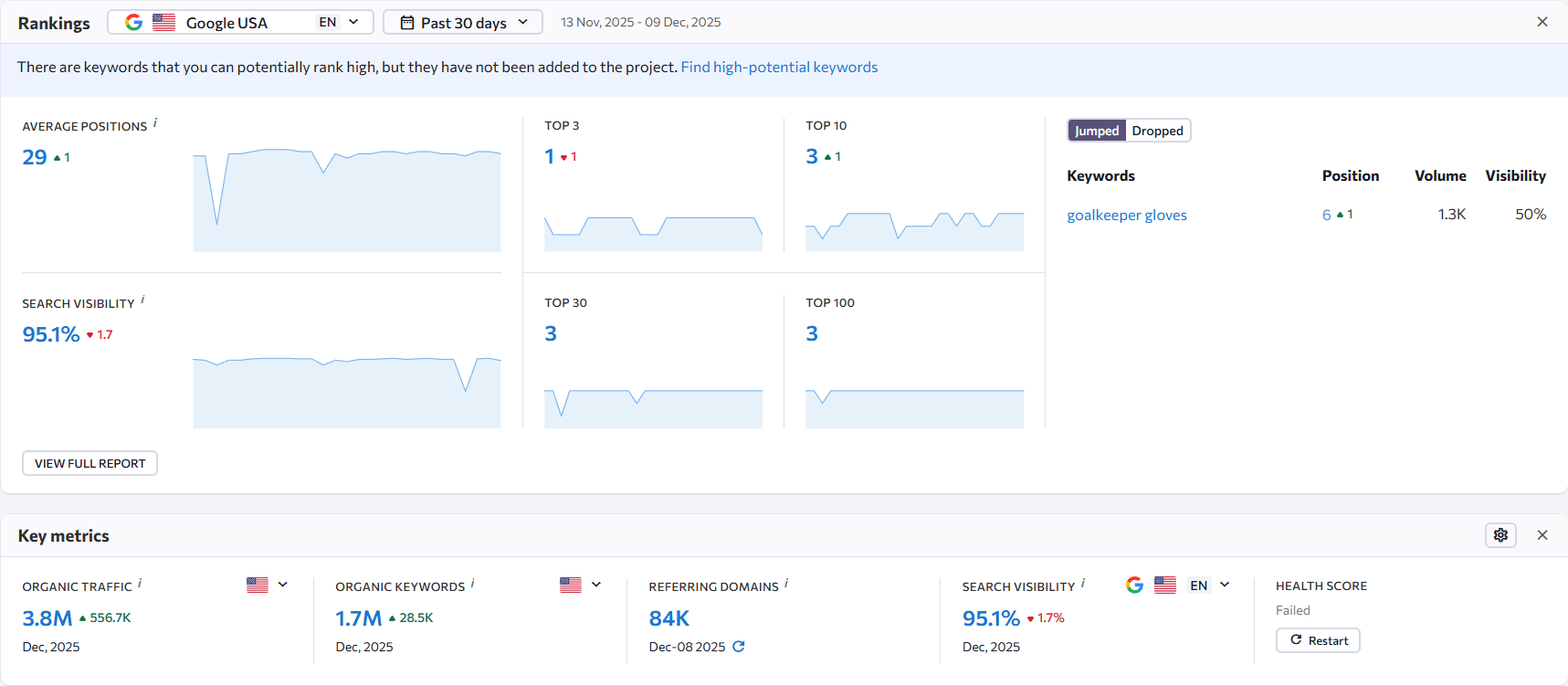
SE Ranking rank tracker dashboard
SE Ranking also keeps longer historical records, which matters once you’ve been publishing for months or years. Being able to compare performance across time periods turns rank tracking into a planning tool rather than a passive report.
Accuracy, Update Frequency & Confidence in the Data
Mangools updates rankings regularly and does a solid job for smaller projects, but its tracking is designed to stay lightweight. You get a reliable snapshot of where you stand without deep diagnostic layers.
SE Ranking’s daily updates and granular controls provide higher confidence for users who depend heavily on organic traffic. When rankings drive business decisions, content updates, or client reporting, this extra accuracy reduces uncertainty and helps avoid overreacting to short-term noise.
Which Rank Tracker Fits Your Workflow Better?
Mangools works best if:
❯ you track a smaller set of keywords and don’t need large-scale monitoring
❯ you want fast visibility checks without digging into complex reports
❯ you prefer simple performance indicators over deep trend analysis
❯ rank tracking supports content creation rather than driving SEO strategy
SE Ranking works better if:
❯ you track dozens or hundreds of keywords across multiple pages
❯ ranking data actively influences what you publish next
❯ competitor movements matter to your SEO decisions
❯ you rely on consistent historical data to measure progress over time
The key difference isn’t feature count — it’s how central rank tracking is to your SEO process.
Site Audits & Technical SEO: Monitoring Health vs Managing Growth
Technical SEO is where many tools reveal their real intent. Some platforms are built to give you a quick sense of site health. Others are designed to help you manage technical SEO continuously as your website grows. SE Ranking and Mangools fall into these two different camps.
Mangools: Light Technical Insights for Quick Checks
Mangools does not position itself as a full technical SEO solution, and that’s intentional. Its SiteProfiler tool offers high-level domain insights rather than a detailed crawl-based audit. You can review basic metrics such as domain authority-style indicators, backlink summaries, top-performing pages, and general visibility signals.
This works well if your site is relatively small or technically simple. You can quickly sanity-check a domain, assess competitors, and confirm that nothing is obviously broken. For content-driven sites with limited technical complexity, this level of insight is often sufficient.
However, Mangools does not crawl your site in depth. It won’t surface detailed issues related to crawl budget, internal link structure, redirect chains, duplicate content, or indexation problems. As a result, it’s not designed to guide technical improvements over time.
Mangools treats technical SEO as context, not a process.
SE Ranking: Full Site Audits Built for Ongoing Optimization
SE Ranking approaches technical SEO very differently. Its site audit feature is built around a crawler that scans your website regularly and tracks issues as they appear or are resolved. Instead of providing a single snapshot, it gives you a structured overview of site health and how it changes over time.
The audit identifies problems related to indexability, page speed, broken links, redirects, duplicate content, metadata gaps, and internal linking. Issues are categorized by severity, which helps you prioritize fixes rather than guess where to start.
This makes SE Ranking far more suitable for growing websites. As your page count increases and your structure becomes more complex, having a tool that continuously monitors technical health becomes less of a “nice to have” and more of a necessity.
How Ongoing Maintenance Feels in Practice
With Mangools, technical SEO is largely manual. You rely on occasional checks, external tools, or intuition to catch issues as your site evolves. That approach works early on but becomes harder to maintain consistently as content volume grows.
SE Ranking reduces that friction by turning maintenance into a repeatable process. You can see which issues are new, which have been fixed, and which continue to affect performance. Over time, this makes technical SEO feel manageable rather than reactive.
The difference isn’t about complexity — it’s about control.
Which Tool Makes Sense for Technical SEO?
Mangools is suitable if:
❯ your site is small or technically straightforward
❯ technical SEO is not a primary focus
❯ you mainly want context rather than diagnostics
SE Ranking is better suited if:
❯ your site is growing steadily
❯ technical issues could impact rankings
❯ you want to monitor changes over time
❯ you prefer structured guidance over manual checks
This is one of the clearest dividing lines between the two tools. Mangools supports SEO at a high level. SE Ranking supports SEO as an ongoing system.
Final Verdict: SE Ranking vs Mangools — Which One Should You Choose in 2025?
The choice between SE Ranking and Mangools isn’t about features on paper. It’s about how you actually plan to use SEO over the next year.
Both tools are well-built, trustworthy, and far better than entry-level options like Ubersuggest. But they serve different mindsets.
Mangools is at its best when SEO is a supporting activity. It helps you research keywords quickly, validate SERPs, and keep an eye on rankings without pulling you into complex workflows. For solo bloggers, niche site builders, and content creators who value speed and simplicity, Mangools feels light, intuitive, and pleasant to use.
SE Ranking is built for people who treat SEO as an ongoing system. It’s designed for consistency: tracking rankings daily, auditing site health regularly, monitoring backlinks, and adjusting strategy as competition increases. For growing sites, freelancers, and small teams, this depth reduces the need for extra tools and manual checks.
If you choose Mangools, you’re choosing clarity and efficiency.
If you choose SE Ranking, you’re choosing control and scalability.
Neither choice is wrong — but choosing the wrong one for your workflow will cost you time later.
Complete Comparison Overview (2025)
Below is a fully populated, mobile-friendly comparison table with current pricing and core positioning, so you don’t need to cross-check elsewhere.
Quick Side-by-Side Overview
| ool | Best For | Free Plan | Starting Price (Monthly) | Starting Price (Annual Avg. Monthly) |
|---|---|---|---|---|
| SE Ranking | All-in-one SEO management & scaling | 14-day free trial | $65 | $52 |
| Mangools | Keyword research & simple SEO workflows | Limited trial | $61 | $37.70 |
Pricing notes (2025):
❯ SE Ranking pricing depends on keyword tracking volume and update frequency. Entry pricing reflects the Essential plan with daily tracking.
❯ Mangools pricing reflects the Basic plan, with full access to all tools but lower usage limits. Annual billing significantly reduces monthly cost.
Final Verdict: SE Ranking vs Mangools — Which One Should You Choose in 2025?
By now, the difference between SE Ranking and Mangools should be clear. Both tools are solid, reputable, and capable — but they’re built for very different types of users and very different SEO mindsets.
Mangools excels when SEO is part of your workflow, not the center of it. It helps you research keywords quickly, evaluate SERPs without friction, and keep an eye on rankings without pulling you into complex dashboards. For solo creators, niche site builders, and bloggers who value speed and simplicity, Mangools feels efficient and easy to live with.
SE Ranking is designed for people who rely on SEO as a growth engine. It brings keyword research, rank tracking, site audits, backlink monitoring, and reporting into one system that’s meant to be used continuously. As your site grows, that structure reduces guesswork and removes the need to juggle multiple tools.
In short:
❯ Mangools helps you move fast
❯ SE Ranking helps you grow with confidence
When Mangools Is the Better Choice
If your priority is content planning and keyword discovery, Mangools does exactly what it promises without overcomplicating things. You get clean data, a friendly interface, and a workflow that makes publishing feel lighter rather than heavier.
When SE Ranking Is the Smarter Investment
If SEO is something you manage week after week — tracking rankings, fixing technical issues, monitoring competitors, and measuring progress — SE Ranking offers far more control. It’s the tool you grow into rather than grow out of.