
Here’s what you’ll find in this guide:
- What actually matters when choosing between Semrush vs Ahrefs
- How to decide between Semrush or Ahrefs quickly
- Which SEO tool is better for keyword research, backlinks, and competitor analysis
- A step-by-step decision framework
Choosing between Semrush and Ahrefs is one of the most common decisions in professional SEO.
Both platforms have evolved far beyond simple keyword research tools. Today they function as complete SEO intelligence platforms used by agencies, SaaS companies, ecommerce brands, and independent website owners who rely on organic traffic.
At first glance the overlap is significant. Both tools allow you to research keywords, analyze competitors, track rankings, audit websites, and evaluate backlink profiles. But once you begin using them in real workflows, meaningful differences start to appear.
Some SEO professionals prefer the depth of Semrush’s marketing ecosystem, which combines SEO, competitor intelligence, and content optimization in one platform. Others gravitate toward Ahrefs because of its clean interface and highly respected backlink database.
The reality is that neither tool is objectively better in every category. Each platform excels in specific areas, and understanding those strengths is what allows you to choose the right tool for your workflow.
This guide breaks down the differences in detail so you can see how each platform performs in the areas that matter most.
Semrush vs Ahrefs Quick Verdict
If you want the short version before diving into the full comparison, the distinction usually comes down to workflow preference and feature priorities.
Semrush positions itself as a broader marketing intelligence platform. Beyond SEO, it integrates PPC research, content optimization tools, keyword clustering, advanced site audits, and competitive advertising insights. For users who want a single platform covering multiple areas of digital marketing, this wider ecosystem can be extremely valuable.
Ahrefs takes a slightly different approach. The platform is heavily focused on search intelligence, with particular strength in backlink analysis, competitor research, and content exploration. Many SEO professionals appreciate the clarity of Ahrefs’ data presentation and the speed with which you can move from keyword research to competitor analysis.
In practical terms, most users eventually gravitate toward one of the platforms based on how they prefer to research keywords, analyze SERPs, and study competing websites.
At a glance, the strengths often look like this:
Semrush is typically chosen for
- advanced keyword discovery and keyword clustering
- deep competitor domain analysis
- technical site audits and SEO monitoring
- integrated marketing tools that extend beyond pure SEO
Ahrefs is often preferred for
- industry leading backlink intelligence
- strong competitor content research
- intuitive workflow for keyword and SERP analysis
- straightforward interface focused primarily on search data
Start your 14-day free trial — no commitment
Access full backlink data instantly — cancel anytime
Semrush pricing and plan comparison inside our full review to choose the right plan based on your SEO goals
Full Ahrefs review with features and pricing breakdown to see if it’s the better fit for your SEO workflow
What You See Inside Semrush and Ahrefs
One of the most useful ways to understand the difference between these tools is simply to look at how their dashboards are structured.
Both platforms organize their features around the core tasks SEO professionals perform every day: keyword research, backlink analysis, competitor intelligence, and website monitoring.
The navigation approach, however, feels quite different once you log in.
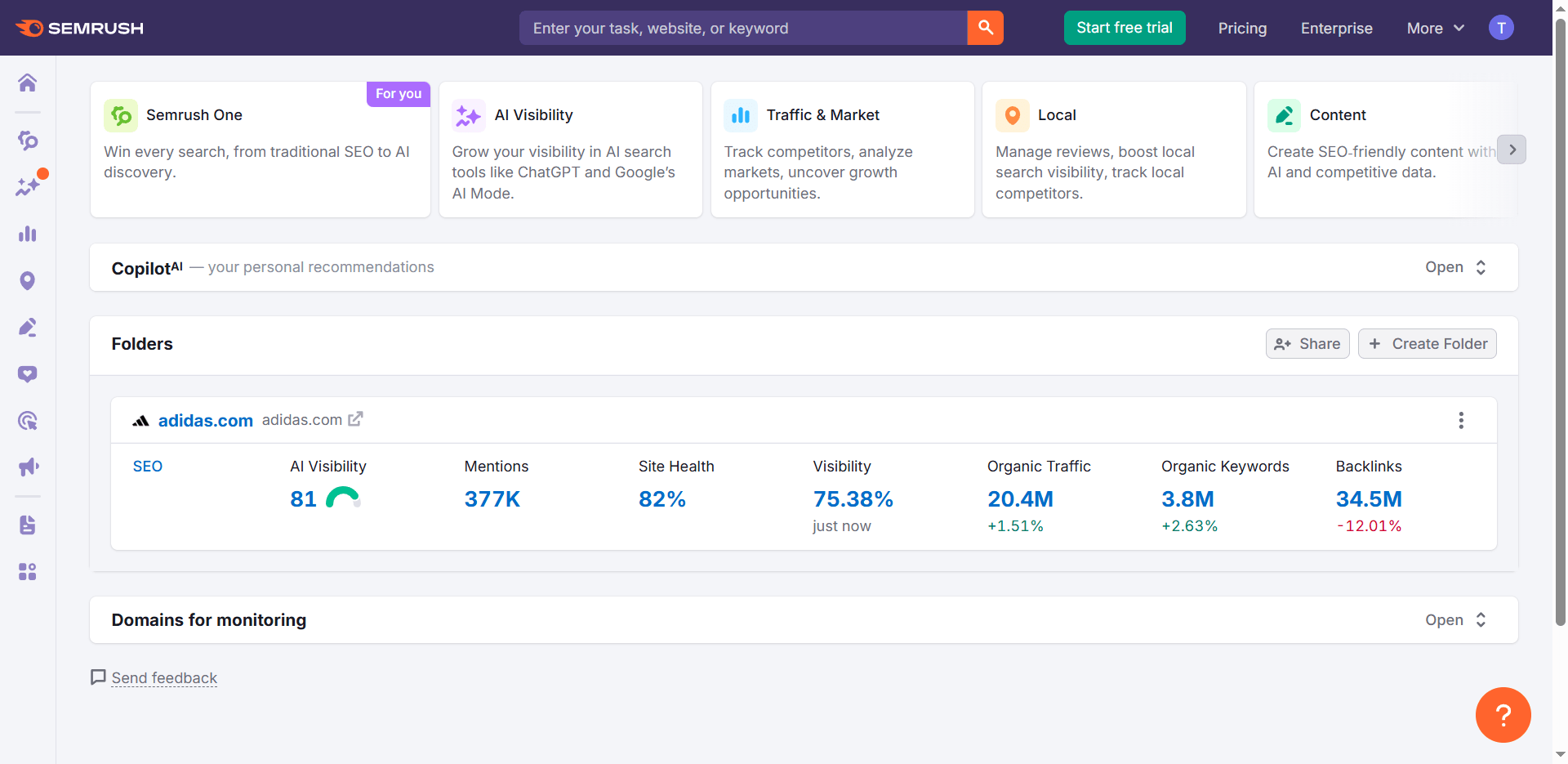
Semrush Main Dashboard Overview
Inside Semrush, tools are grouped into broader marketing categories such as SEO, advertising research, content marketing, and competitor intelligence. This structure reflects Semrush’s goal of functioning as a full digital marketing platform rather than just an SEO toolkit.
Ahrefs takes a more streamlined approach.
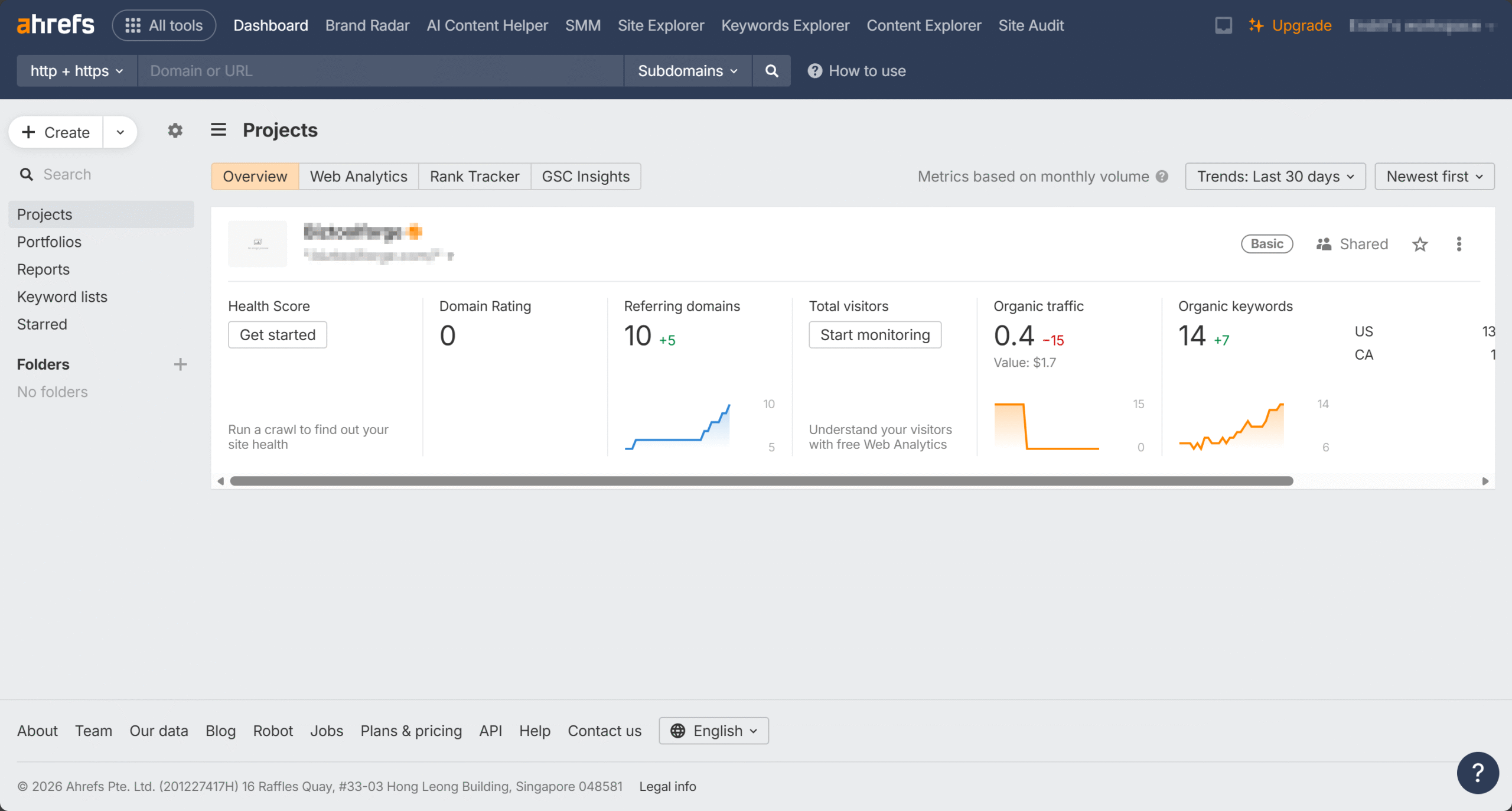
Ahrefs Main Dashboard Overview
The Ahrefs interface focuses almost entirely on search data. Tools like Site Explorer, Keywords Explorer, Content Explorer, and Rank Tracker are placed at the center of the navigation. The layout is intentionally simple, allowing users to move quickly between keyword research, backlink analysis, and competitor investigation.
That difference in philosophy becomes more noticeable as we explore each platform in detail.
Semrush Overview
Semrush has grown into one of the most comprehensive SEO and digital marketing platforms available today. While it originally gained traction as a competitive intelligence tool, it has gradually evolved into a full scale ecosystem that covers nearly every aspect of search marketing.
For many SEO professionals, the appeal of Semrush is not just the depth of individual tools but the way they connect together. Keyword research, competitor analysis, content optimization, and technical audits all live inside the same platform, allowing you to move seamlessly from one workflow to another.
When you open the Semrush dashboard, the SEO toolkit is typically where most users begin their work.
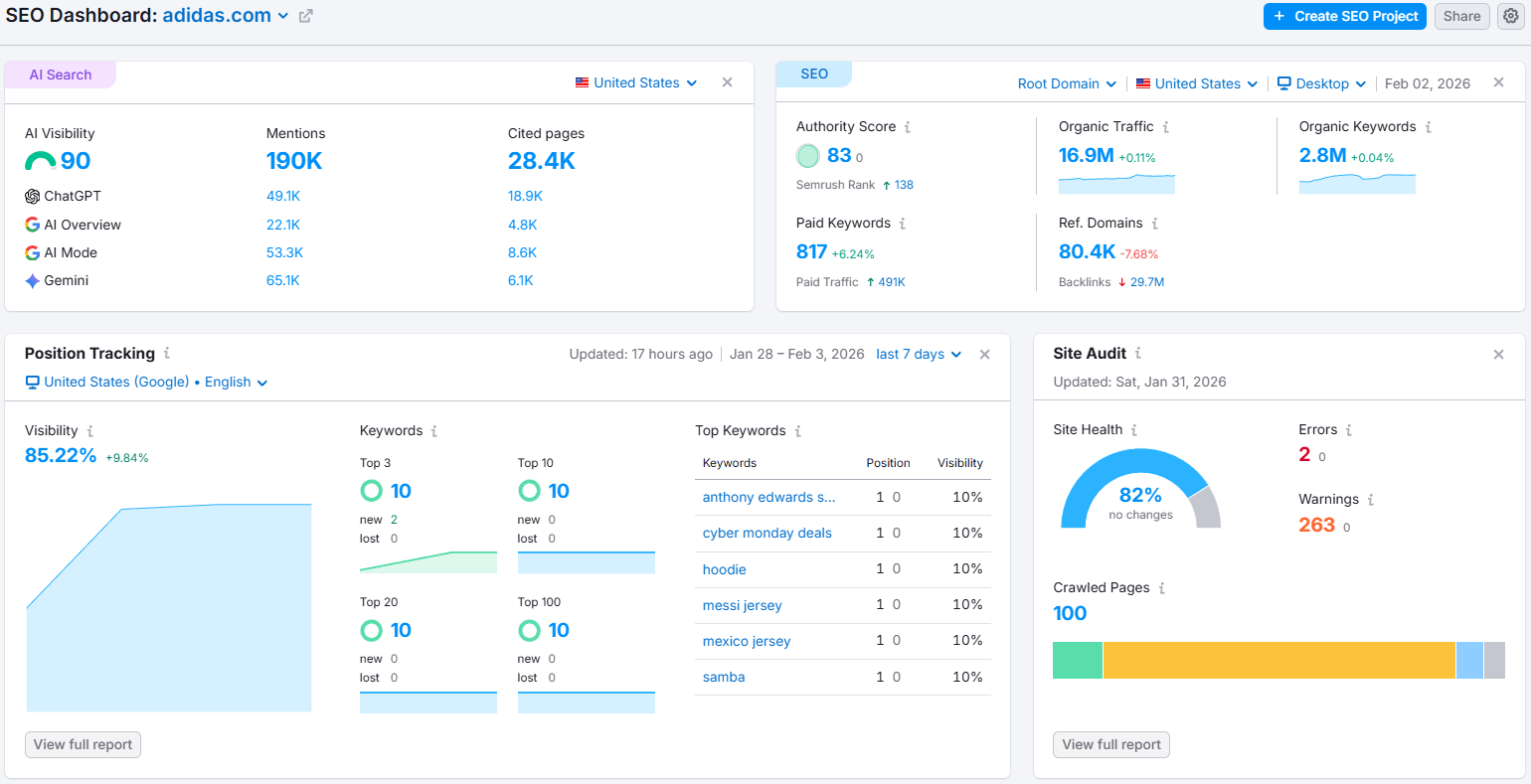
Semrush SEO Toolkit dashboard
From here you can quickly access tools designed for keyword discovery, backlink analysis, site auditing, and competitor intelligence.
Core SEO Tools Inside Semrush
Semrush organizes its SEO capabilities into several specialized tools, each focused on a specific part of the optimization process. Instead of relying on one large dashboard, the platform separates tasks into dedicated research environments.
Some of the most frequently used tools include:
Keyword Magic Tool
This is Semrush’s primary keyword discovery engine. It allows users to generate thousands of keyword variations from a single seed term while filtering results by search volume, keyword difficulty, intent, and SERP features.
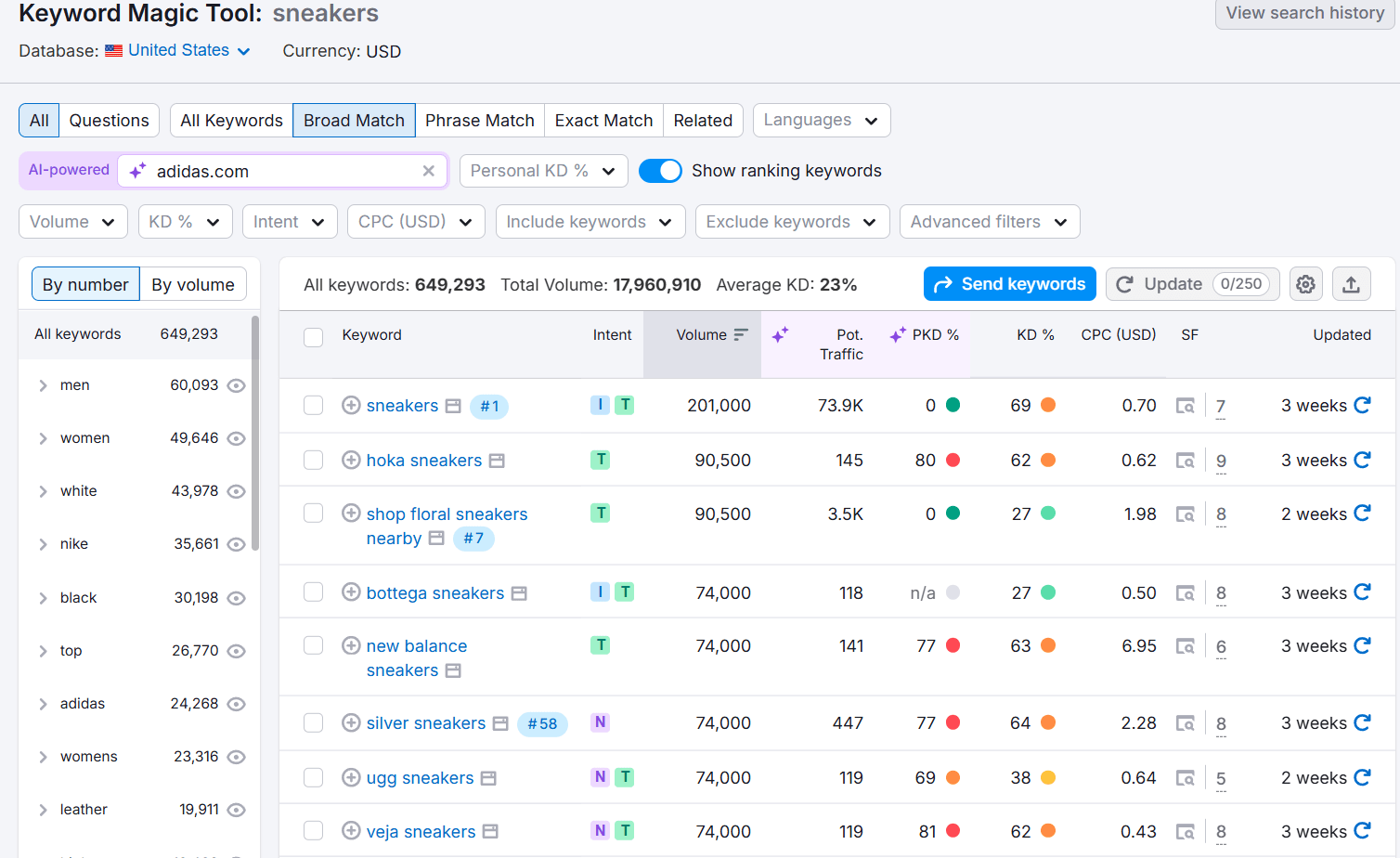
Semrush Keyword Magic Tool Results Interface
One reason many SEO professionals rely on this tool is the ability to uncover long tail opportunities quickly. Instead of returning only closely related keywords, the tool expands into topic clusters and semantic variations that often reveal content ideas competitors have missed.
Domain Overview
The Domain Overview feature gives a snapshot of any website’s organic visibility, ranking keywords, backlink profile, and traffic trends. It is commonly used to evaluate competitors or understand how established sites in a niche are performing.
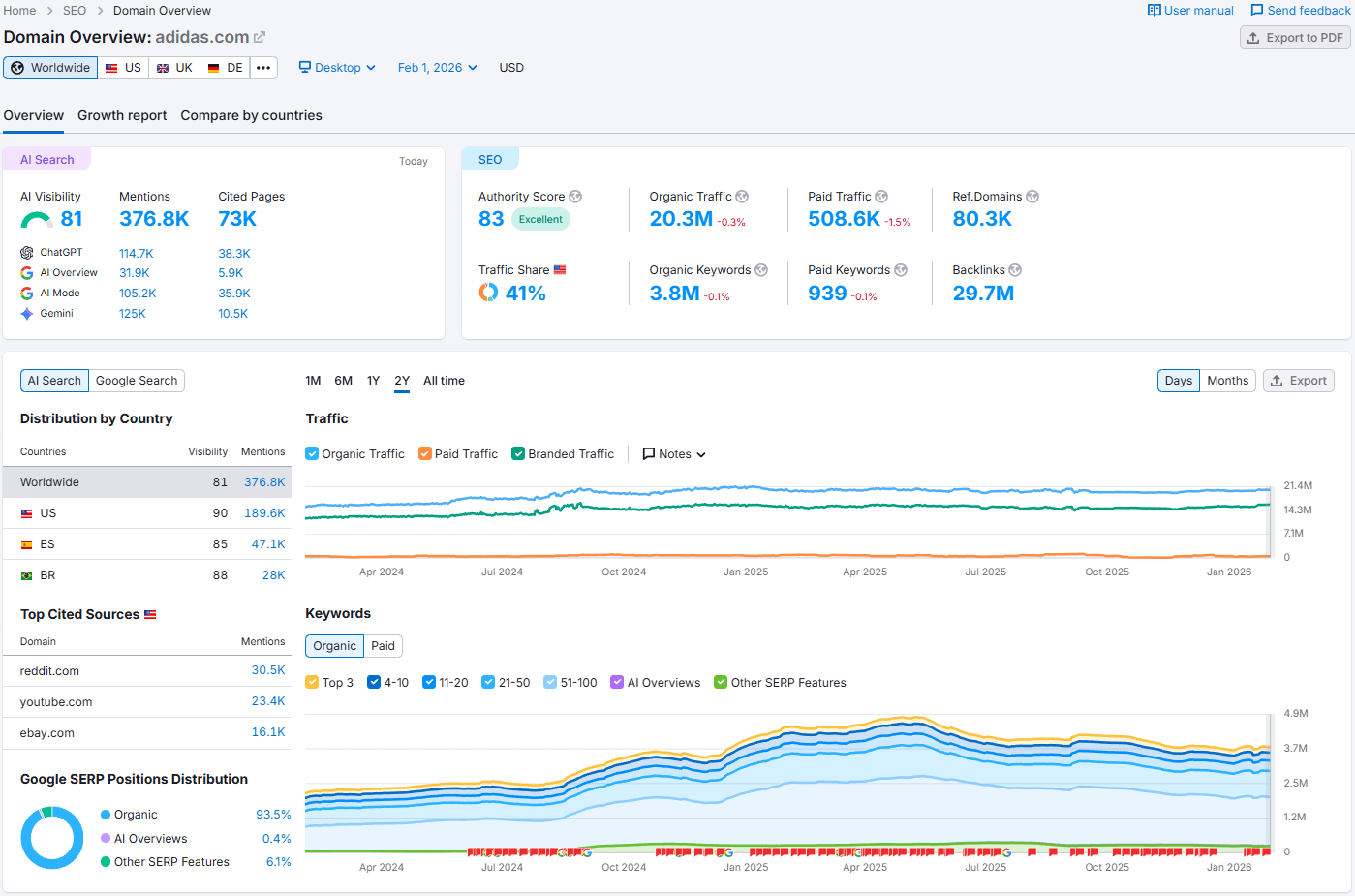
Semrush Domain Overview Report
By combining traffic estimates with ranking keyword data, the tool helps you identify which pages are driving visibility for competing websites.
Site Audit
Technical SEO is another area where Semrush has invested heavily. The Site Audit tool scans your website for crawl errors, indexing problems, duplicate content, slow pages, and dozens of other technical issues that can affect search performance.
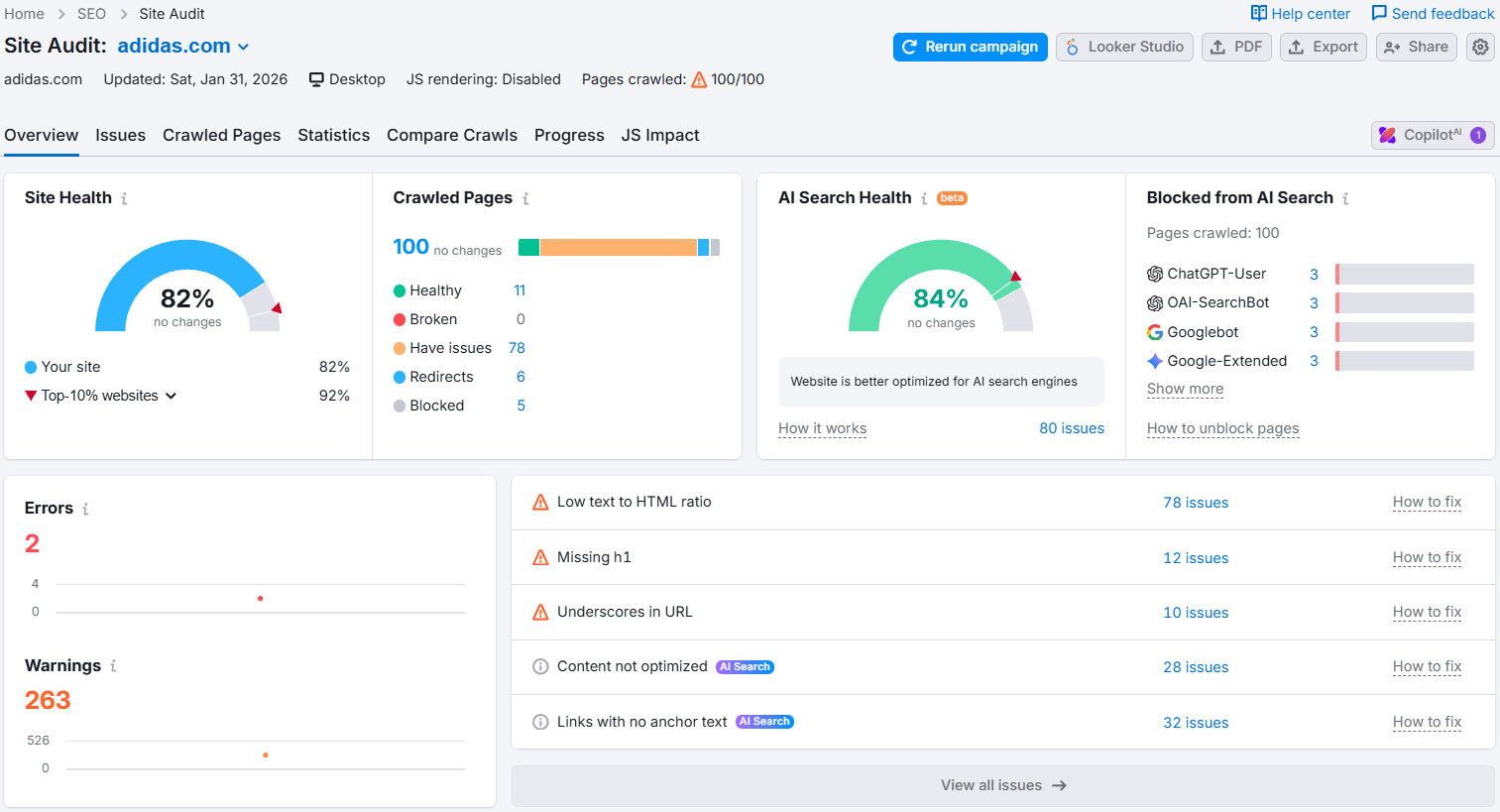
Semrush Site Audit Report Dashboard
The audit system organizes issues by severity and provides explanations for each problem, making it easier to prioritize fixes.
Where Semrush Is Strongest
Although Semrush offers a large number of tools, several areas stand out as particular strengths.
First, the platform excels at keyword expansion and topic discovery. The Keyword Magic Tool alone can generate massive keyword lists that reveal new angles for content creation. For sites that rely heavily on search driven content strategies, this ability to surface long tail opportunities can be extremely valuable.
Second, Semrush provides strong competitive domain intelligence. With just a domain name, you can analyze which keywords competitors rank for, how their organic visibility has evolved over time, and which pages generate the most traffic.
Another advantage is the integration between tools. For example, keywords discovered in Keyword Magic Tool can be added directly to tracking campaigns or incorporated into content optimization workflows inside the platform.
Finally, Semrush extends beyond pure SEO. Users can also analyze advertising data, monitor brand mentions, research display ads, and evaluate marketing campaigns across multiple channels. For teams managing broader digital marketing strategies, this expanded scope can make Semrush particularly appealing.
Ahrefs Overview
Ahrefs is widely known for its powerful backlink intelligence and straightforward approach to search data analysis. While it now offers a wide set of SEO tools, the platform’s reputation was built primarily on its link index and the depth of insight it provides into competitor websites.
Compared with Semrush, Ahrefs tends to emphasize clarity and simplicity in its interface. Most research workflows begin with a tool called Site Explorer, which functions as the central hub for analyzing domains, URLs, and backlink profiles.
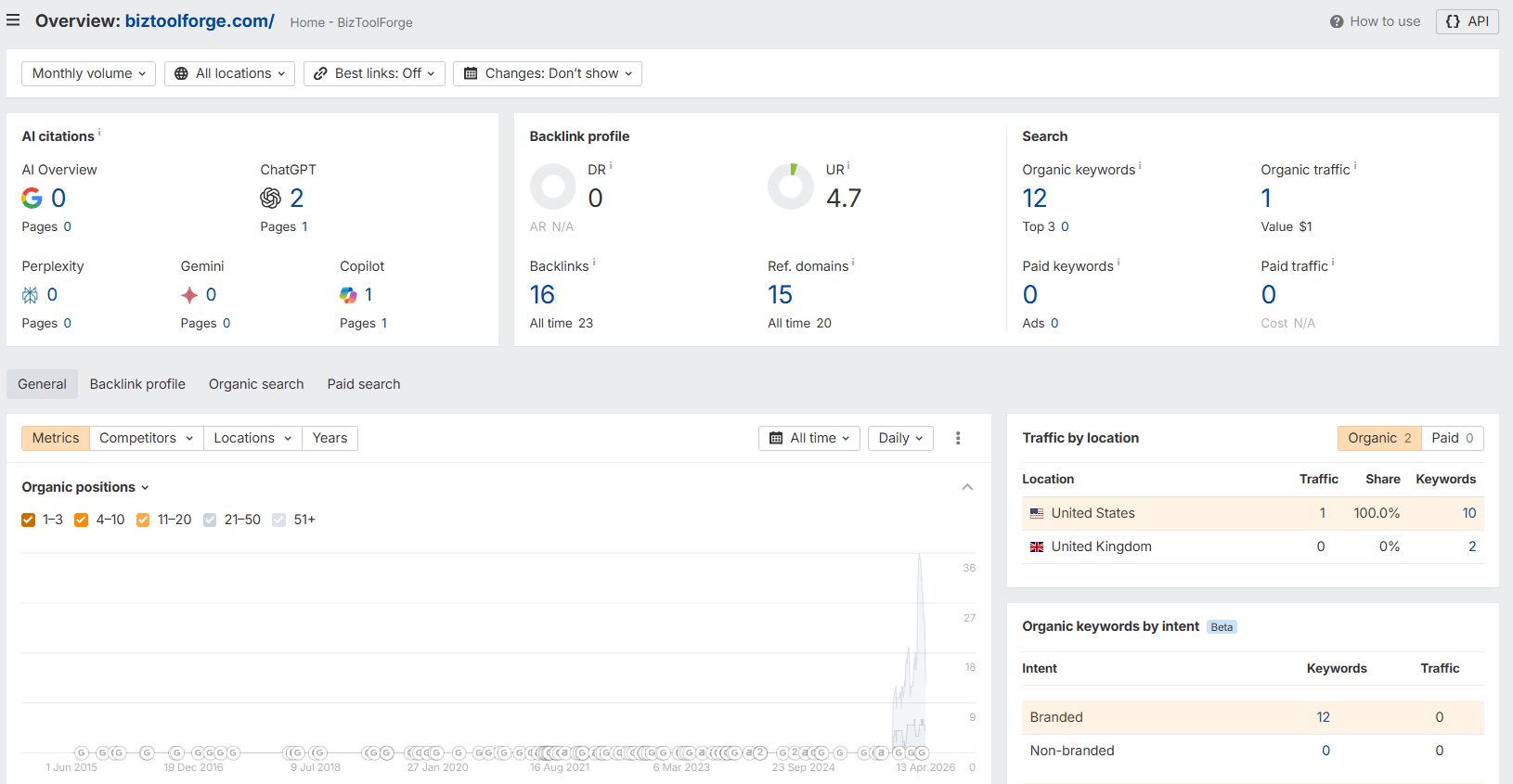
Ahrefs Dashboard With Site Explorer Open
Once a domain is entered, the platform generates a detailed report that includes backlink data, organic keywords, ranking pages, traffic estimates, and historical visibility trends.
Core Tools Inside Ahrefs
Ahrefs focuses its platform around several key tools that address the main areas of SEO research.
Site Explorer
Site Explorer is the core of Ahrefs and where most competitor analysis starts.
Instead of just showing surface level metrics, it lets you break down any domain or URL to see how it actually generates organic traffic. You can quickly identify:
- which keywords a site ranks for
- which pages drive the most traffic
- which backlinks support those rankings
What makes this tool particularly useful is how everything connects. From a single domain, you can move into top pages, then into ranking keywords, and then into backlink data without leaving the workflow.
This makes it very efficient for reverse engineering competitors. Rather than guessing what works, you can see exactly which pages are performing and why.
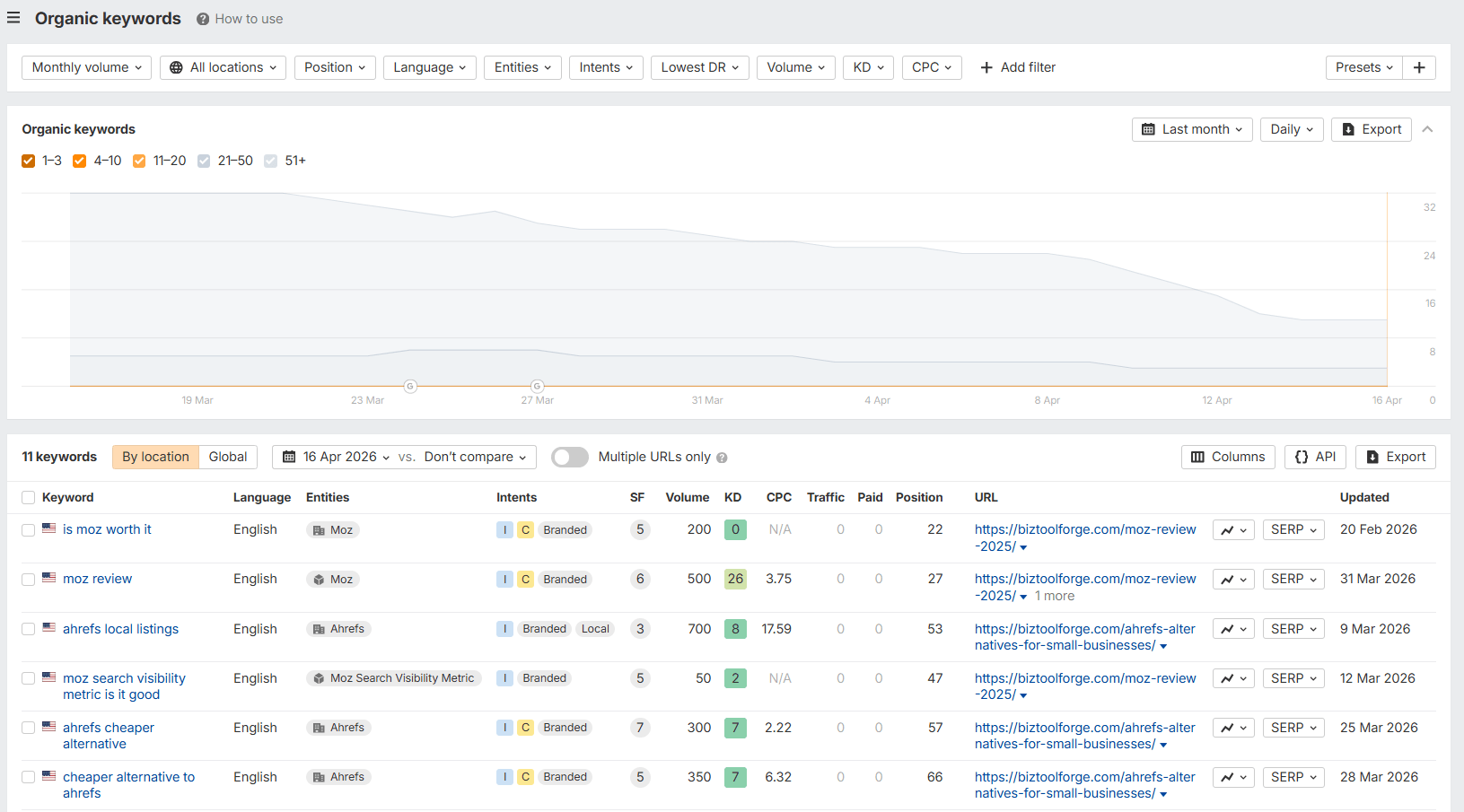
Ahrefs Site Explorer Organic Keywords Report
This tool is frequently used to reverse engineer competitor strategies by identifying their most successful pages and the keywords driving traffic to those pages.
Keywords Explorer
Ahrefs’ Keywords Explorer focuses on one practical question.
What does it actually take to rank for this keyword?
Instead of just showing metrics, it breaks down the current SERP by exposing:
- top ranking pages
- their backlink profiles
- estimated traffic
- ranking stability over time
This makes it easier to judge real competition, not just numbers.
Keyword ideas are also structured in a way that supports content planning. Rather than overwhelming lists, results are grouped into:
- matching terms
- related terms
- questions
This helps surface long tail opportunities tied to search intent, especially when building topic focused content.
Ahrefs’ keyword difficulty is primarily based on backlink requirements of top ranking pages. This gives a quick, practical signal of how competitive a keyword is based on link strength.
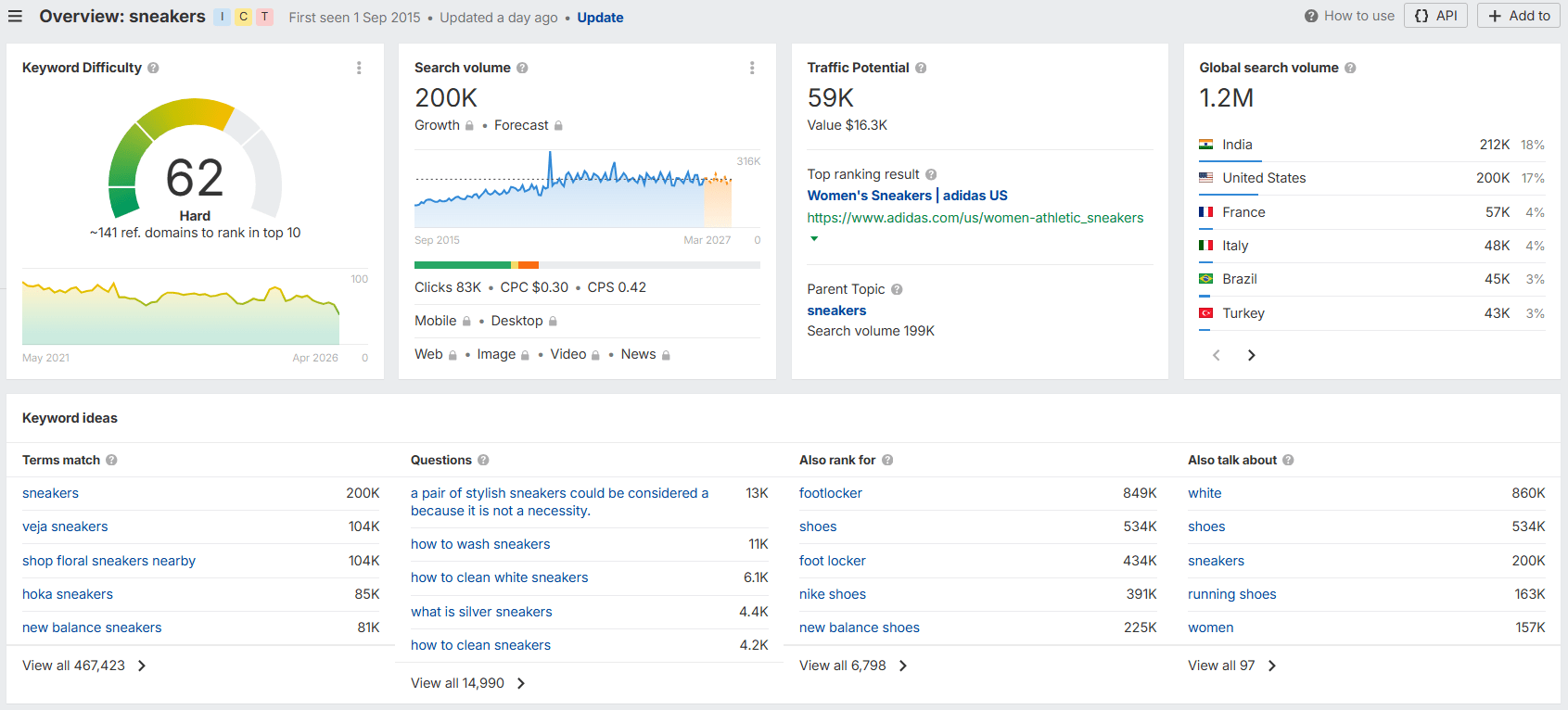
Ahrefs Keywords Explorer Results Page
One of the distinguishing features here is Ahrefs’ keyword difficulty metric, which estimates ranking difficulty based on backlink profiles of top ranking pages.
Content Explorer
Content Explorer is Ahrefs’ discovery engine for finding content that already performs well in your niche.
Instead of starting with keywords alone, it lets you search for topics and see which pages attract the most traffic, backlinks, and visibility across the web. This shifts your research from guessing ideas to analyzing proven content.
You can quickly identify:
- pages that earn the most backlinks
- topics that consistently attract traffic
- content formats that perform well in your niche
This is particularly useful when planning linkable assets or trying to understand what type of content naturally earns authority.
Another practical use is filtering results by metrics like referring domains or organic traffic. This allows you to narrow down results to high impact opportunities, rather than scrolling through generic content ideas.
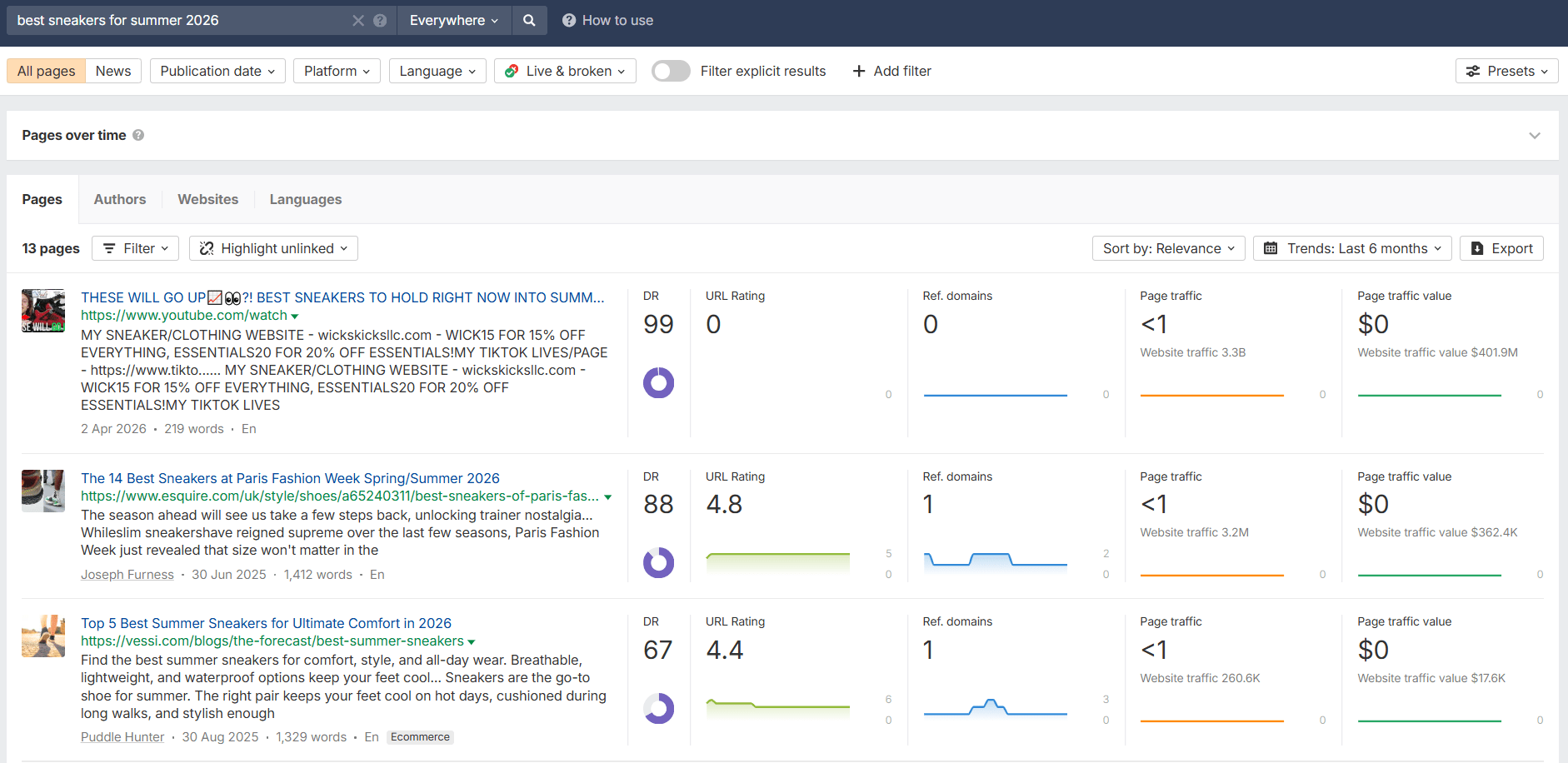
Ahrefs Content Explorer Results Page
By analyzing how frequently content is shared or linked to, the tool can help identify topics that attract attention within a niche.
Where Ahrefs Excels
Ahrefs is often praised for the quality of its backlink data. The platform continuously crawls the web to discover new links and maintains one of the largest link indexes available to SEO professionals.
Because of this strength, Ahrefs is widely used for tasks such as:
- analyzing competitor link profiles
- discovering new link building opportunities
- evaluating the authority of referring domains
- identifying pages that attract natural backlinks
Another area where Ahrefs performs particularly well is competitor content analysis. The platform makes it easy to identify which pages drive the most organic traffic for a competing website and which keywords contribute to that visibility.
This ability to quickly reverse engineer competitor strategies is one reason many SEO professionals rely heavily on Ahrefs during the research phase of a project.
Semrush vs Ahrefs for Keyword Research
Keyword research is where most SEO workflows begin, and it is also one of the areas where the differences between Semrush and Ahrefs become very noticeable.
Both platforms maintain massive keyword databases and provide detailed metrics such as search volume, keyword difficulty, and SERP analysis. However, the way they help you discover opportunities and evaluate ranking difficulty is quite different.
Semrush is often praised for its keyword expansion capabilities and the depth of filters available when generating ideas. Ahrefs, by contrast, is widely respected for its straightforward keyword difficulty model and its ability to show how competitors are ranking for specific queries.
Understanding these differences can help you choose the right research workflow depending on what you are trying to achieve.
Finding Low Competition Keyword Opportunities
Finding low competition keywords is one of the most valuable tasks any SEO tool can perform. These are the search queries where ranking is realistically achievable, even for newer websites.
Semrush approaches this process through its Keyword Magic Tool, which is designed to expand a single keyword into thousands of related search variations.
Semrush Keyword Magic Tool Generating Keyword Ideas
Once results appear, the tool allows you to filter keywords using several metrics that help identify easier ranking opportunities.
Some of the most useful filters include:
- keyword difficulty
- search volume
- search intent
- cost per click
- SERP features
By combining these filters, you can isolate long tail queries with moderate search demand and relatively low competition.
For example, instead of targeting a broad keyword like SEO tools, the platform might reveal opportunities such as more specific variations that attract targeted traffic but face less competition.
This type of discovery process is where Semrush tends to excel. The sheer volume of keyword variations generated often reveals content angles that competitors have not fully explored.
Ahrefs approaches keyword discovery slightly differently through its Keywords Explorer tool.
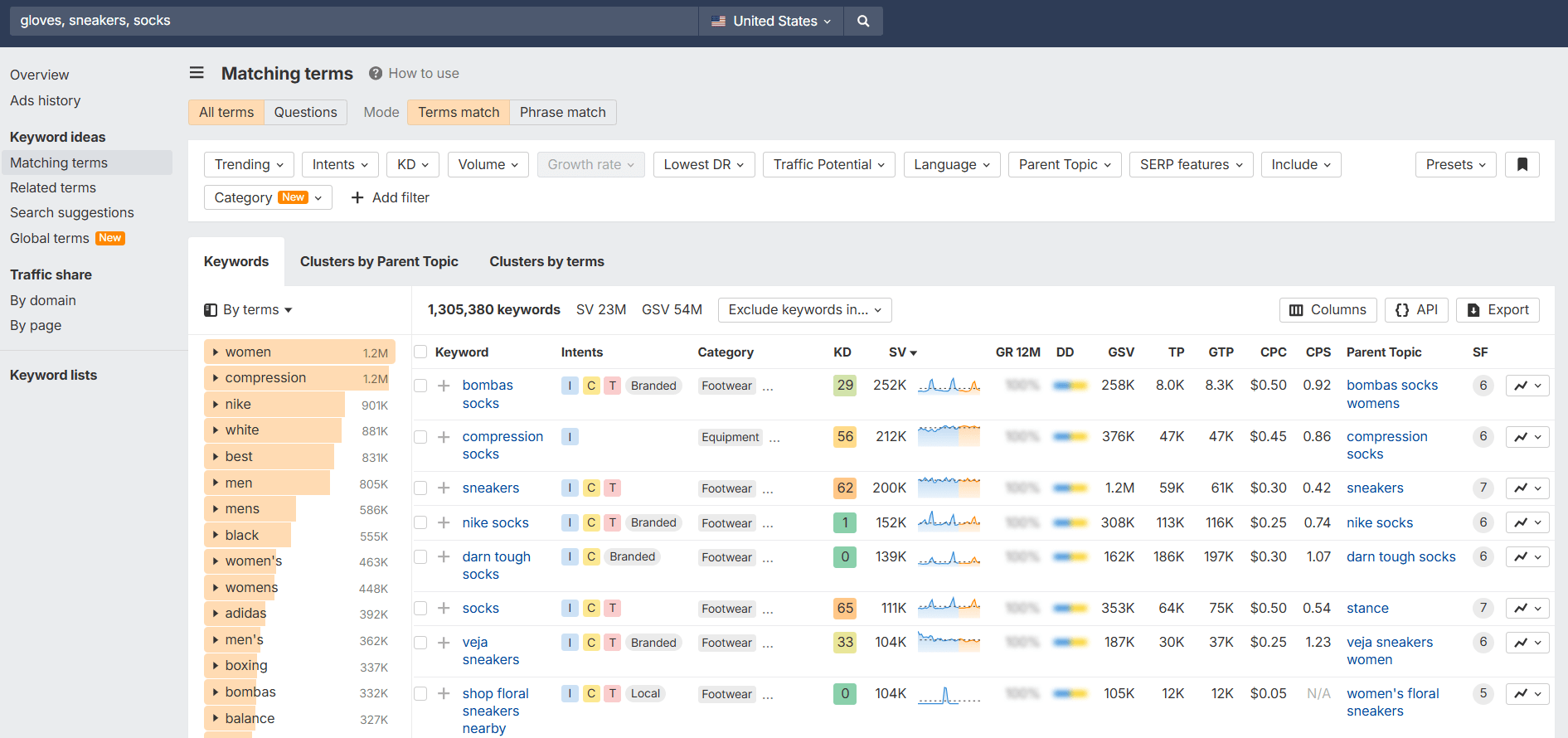
Ahrefs Keywords Explorer Keyword Suggestions Report
Rather than overwhelming users with thousands of variations immediately, Ahrefs organizes suggestions into categories such as matching terms, related terms, and questions.
This structure makes it easier to analyze the search intent behind keywords and quickly understand what users are actually looking for.
Many SEO professionals appreciate how Ahrefs highlights SERP composition, showing whether top ranking pages rely heavily on backlinks or whether newer pages are successfully ranking with lower authority.
Keyword Difficulty Accuracy
Keyword difficulty metrics are one of the most misunderstood aspects of SEO tools. Every platform calculates difficulty differently, and neither Semrush nor Ahrefs provides a perfect prediction of ranking success.
Semrush calculates keyword difficulty by analyzing the authority of domains ranking on the first page of search results. The tool considers multiple factors, including backlink profiles, domain authority signals, and overall SERP competitiveness.
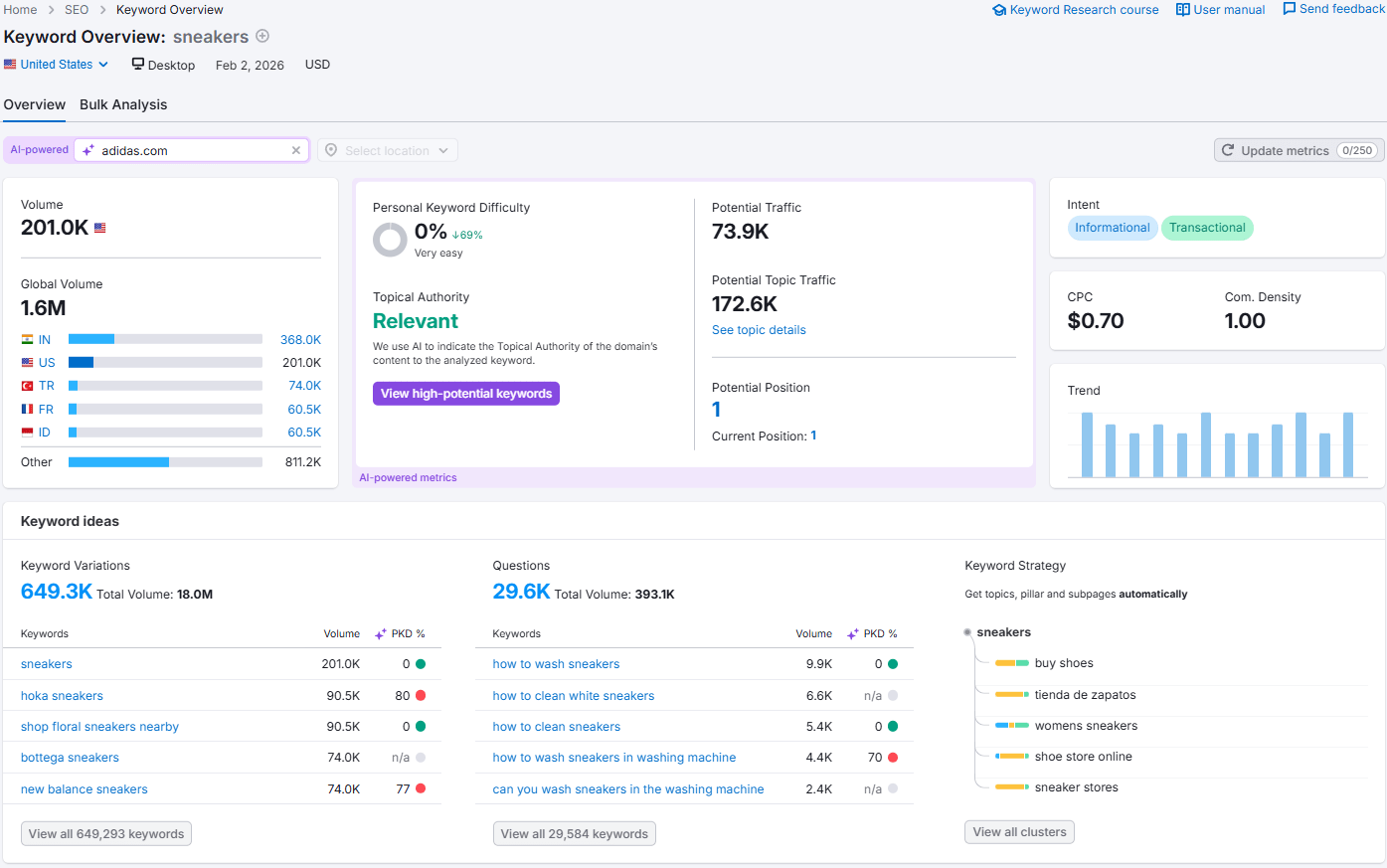
Semrush Keyword Overview Difficulty Score
The result is a percentage based difficulty score that estimates how challenging it might be to enter the top rankings for that keyword.
Ahrefs takes a more specific approach.
Its keyword difficulty score focuses primarily on backlink requirements, estimating how many referring domains are typically needed to rank on the first page.
This backlink focused model can be very useful when evaluating how strong the link profiles of top ranking pages are. However, it also means the metric may not fully capture factors such as content quality, search intent alignment, or internal linking strategies.
Because of this, many experienced SEO professionals treat keyword difficulty as a directional signal rather than a strict rule.
Keyword Clustering and Topic Discovery
One area where Semrush has expanded significantly in recent years is topic clustering and content planning.
The platform includes tools that group keywords by semantic similarity, allowing you to build content structures around entire topics instead of individual keywords.
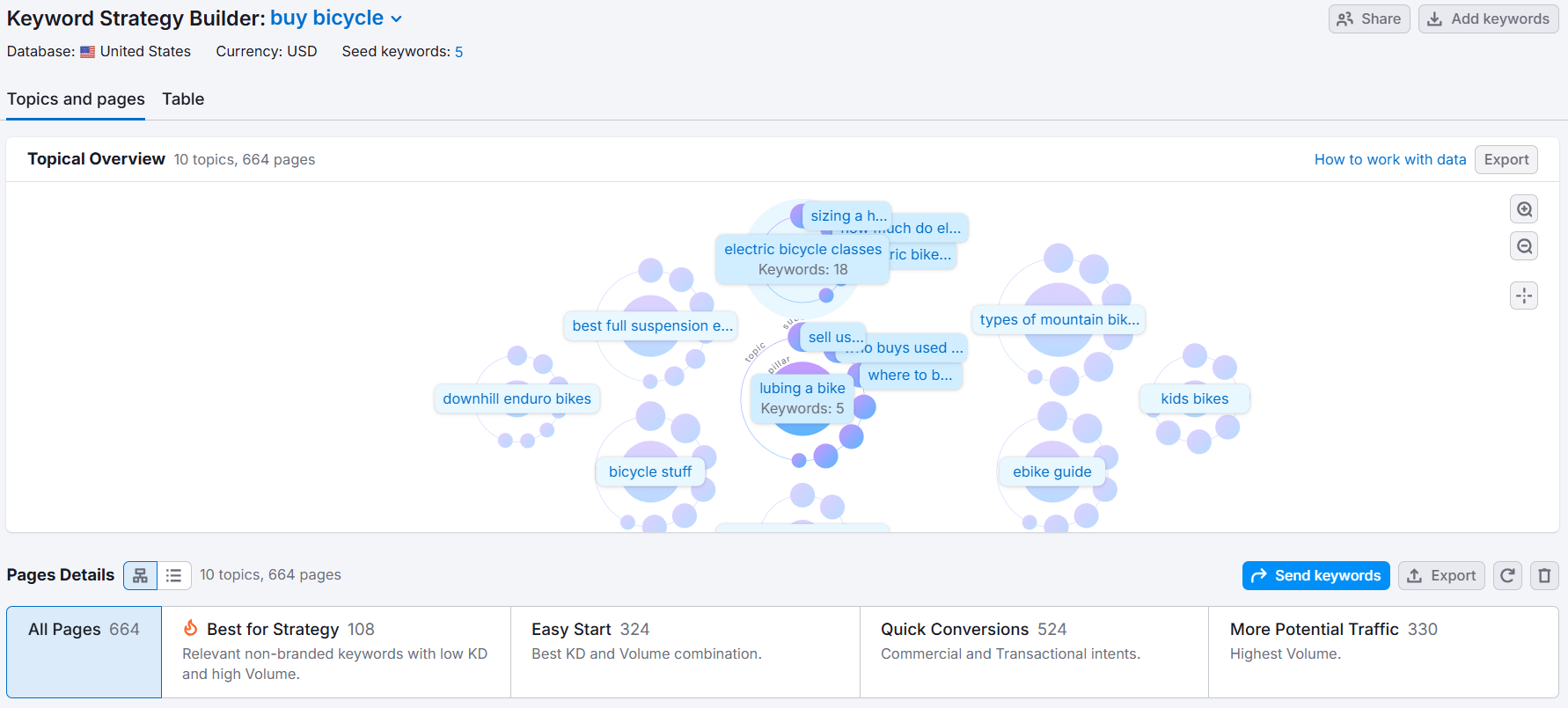
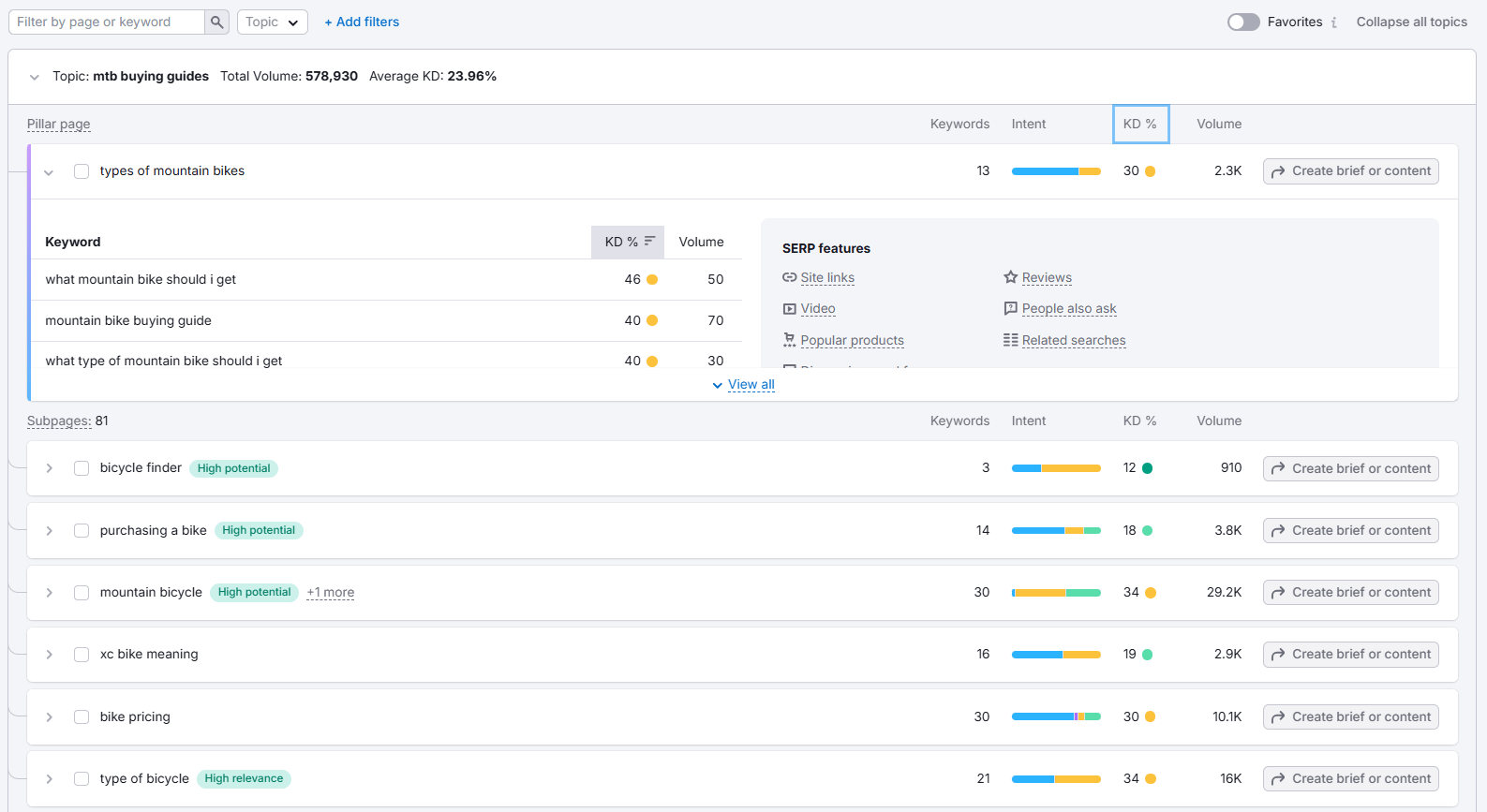
Semrush Keyword Strategy Builder Cluster Results
Instead of creating separate pages for dozens of similar keywords, this approach helps you design content that targets entire topic clusters.
For websites aiming to build topical authority, this feature can be particularly valuable because it simplifies the process of organizing keyword research into content strategies.
Ahrefs does not currently offer the same level of automated clustering. However, its Content Explorer and Top Pages reports can reveal how competing websites structure their content and which topics generate the most organic traffic.
By analyzing which pages perform best for competitors, you can identify topic gaps and content opportunities that may not be obvious from keyword lists alone.
- Read How to build topical authority for SEO to learn how to structure your content for higher rankings and authority
Explore the Best keyword research tools for SEO to find the right tools for uncovering profitable keywords
Semrush vs Ahrefs for Backlink Analysis
Backlinks remain one of the strongest signals used by search engines to evaluate authority and trust. Because of this, the ability to analyze link profiles accurately is one of the most important capabilities any SEO platform can offer.
Both Ahrefs and Semrush have invested heavily in their backlink databases, but historically Ahrefs built its reputation around link intelligence. Many SEO professionals originally adopted Ahrefs specifically because of the scale and speed of its web crawler.
Semrush has significantly improved its link database over the past few years and now offers a very competitive backlink analysis environment. However, the workflow and the way insights are presented still differ between the two platforms.
Understanding those differences becomes important when you start researching competitor links or planning outreach campaigns.
Backlink Database Size and Coverage
When analyzing a domain in Ahrefs, you can immediately see several key metrics that describe the strength of a site’s link profile.
The most commonly referenced metrics include:
- referring domains
- total backlinks
- domain rating (DR)
- URL rating (UR)
- new and lost backlinks over time
This overview makes it easy to quickly evaluate how authoritative a domain appears from a link perspective.
Semrush provides similar insights through its Backlink Analytics tool.
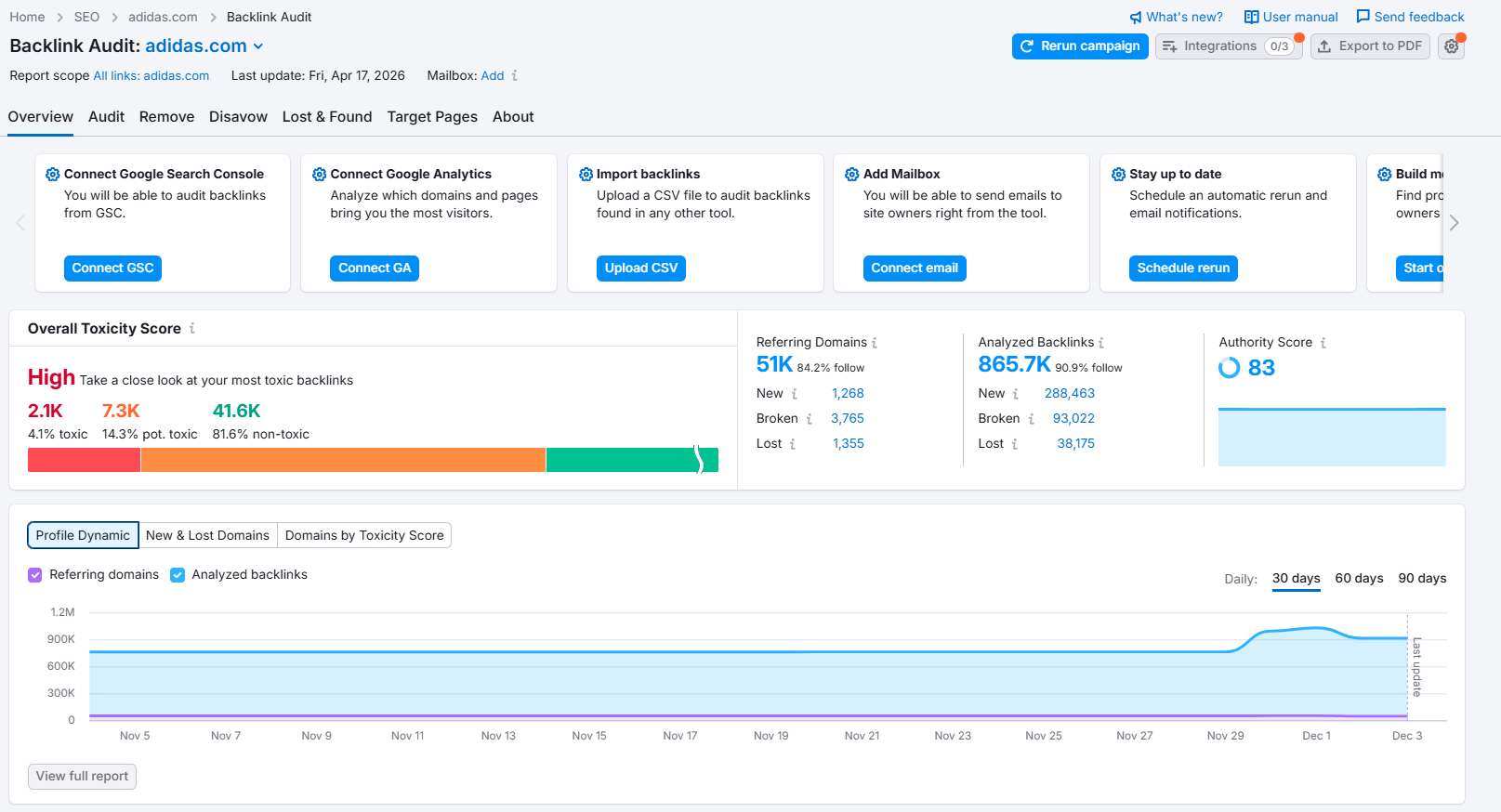
Semrush Backlink Audit Dashboard
The platform reports several comparable metrics, although the naming conventions differ slightly.
Typical link metrics displayed include:
- authority score
- referring domains
- total backlinks
- follow vs nofollow links
- backlink types (text, image, form, frame)
For most practical SEO workflows, both tools provide more than enough data to evaluate link profiles. The difference is less about raw numbers and more about how easily you can extract actionable insights.
Competitor Link Research
One of the most powerful uses of backlink analysis tools is identifying where competitors are getting their links. This process often reveals websites that may also be willing to link to your content.
Ahrefs makes competitor link research very straightforward. Once you enter a competing domain in Site Explorer, the platform shows a complete list of referring domains along with the specific pages that link to the site.
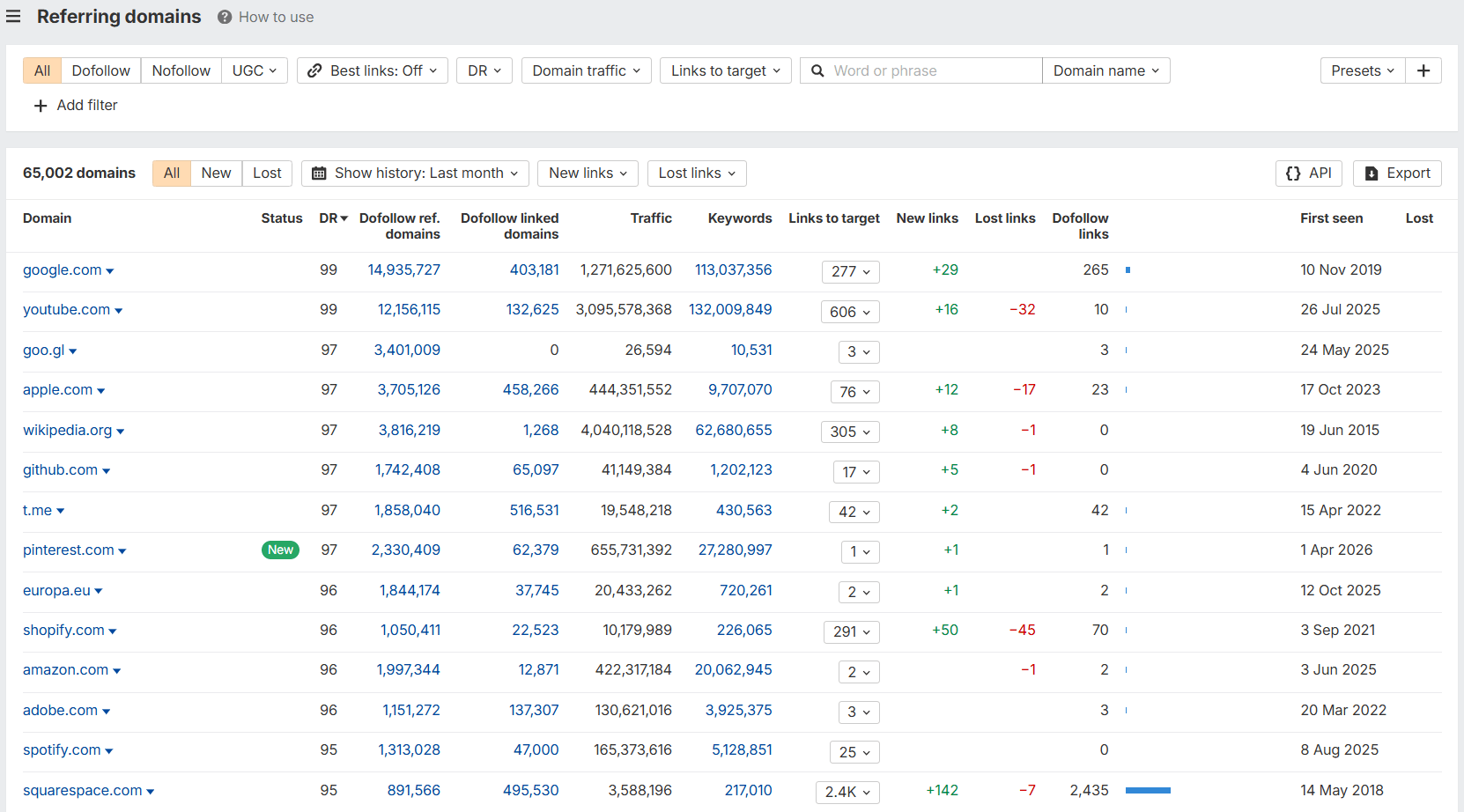
Ahrefs Referring Domains Report
This tool analyzes your website alongside several competitors and then suggests potential link prospects based on the domains linking to those competitors.
The workflow typically looks like this:
- Enter your domain
- Add several competing websites
- Allow Semrush to analyze backlink gaps
- Review suggested link prospects
This approach blends research and outreach planning into a single workflow, which many users find convenient when managing active link building campaigns.
Finding Link Building Opportunities
Beyond simply analyzing backlinks, both platforms try to help users discover new linking opportunities.
Ahrefs tends to focus on content driven link discovery. By analyzing the most linked pages within a niche, the platform can reveal which types of content attract natural backlinks.
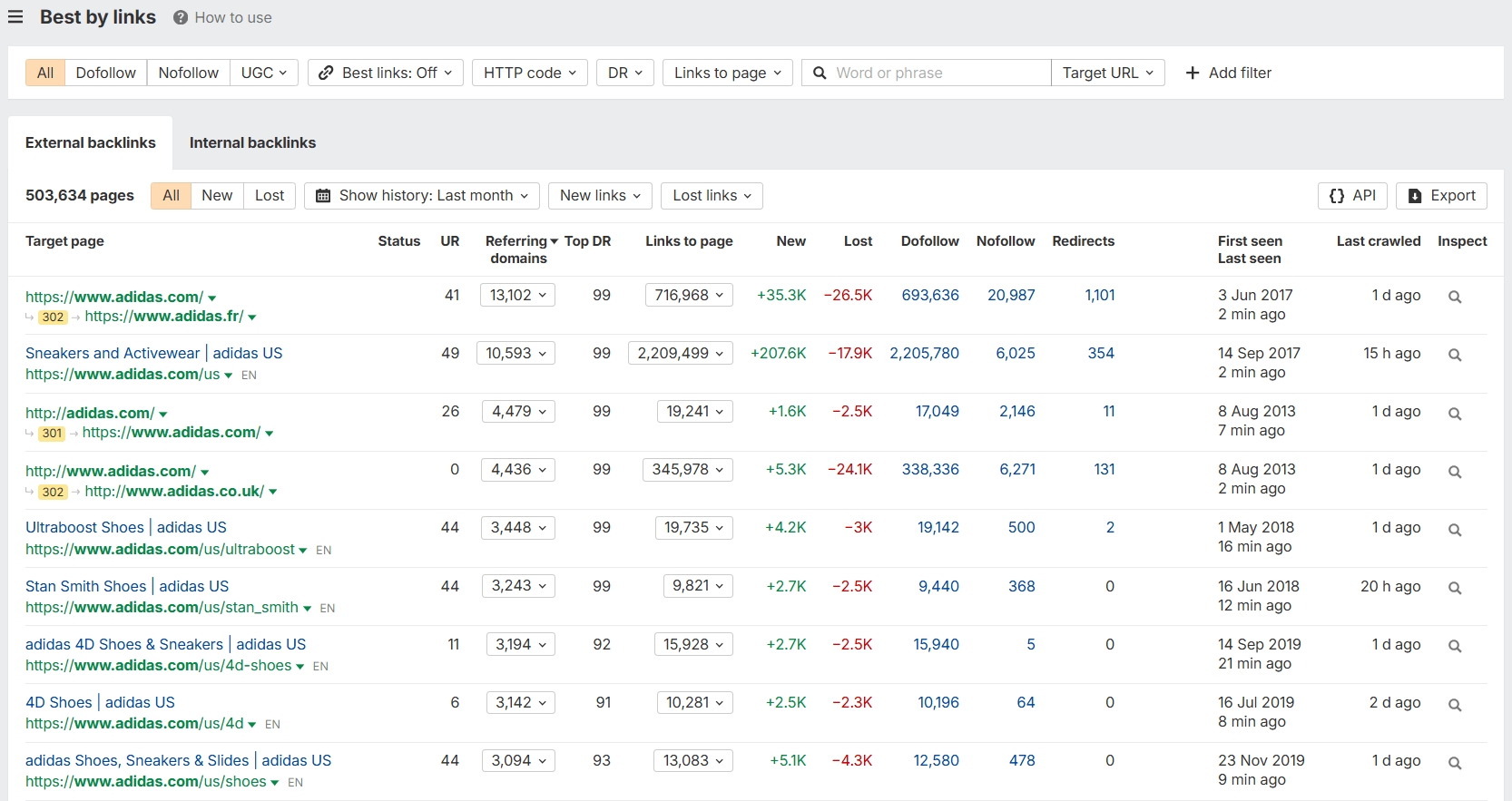
Ahrefs Best by Links Report
This report highlights pages that have attracted the largest number of referring domains. These pages often represent content formats that naturally earn links, such as research reports, tools, or in depth guides.
Studying these patterns can help you design content that has a higher probability of attracting backlinks organically.
Semrush complements this type of analysis with tools designed to actively generate outreach opportunities.
For example, the Link Building Tool can automatically identify domains that:
- link to multiple competitors
- publish content related to your niche
- have authority scores that suggest credible websites
By combining backlink data with prospect suggestions, the platform effectively turns competitor analysis into a list of potential outreach targets.
Dive into our Complete guide to link building for SEO if you’re looking to scale your backlink strategy the right way
Check out How to analyze competitor backlinks to find proven link sources your competitors are already using
Semrush vs Ahrefs for Content Strategy and Competitive Research
Beyond keywords and backlinks, one of the most valuable uses of SEO platforms is understanding what content already works in your niche. Instead of guessing what to publish next, you can analyze competitors and identify pages that consistently generate traffic.
Both Semrush and Ahrefs offer strong competitive research capabilities, but they approach the problem from slightly different angles.
Semrush tends to integrate multiple research tools into a broader content planning workflow. Ahrefs focuses more on reverse engineering what already performs well across the web.
Finding Competitor Content Opportunities
One of the fastest ways to identify content opportunities is to analyze which keywords your competitors rank for but your site does not. This process is commonly referred to as content gap analysis.
Semrush includes a dedicated tool for this task.
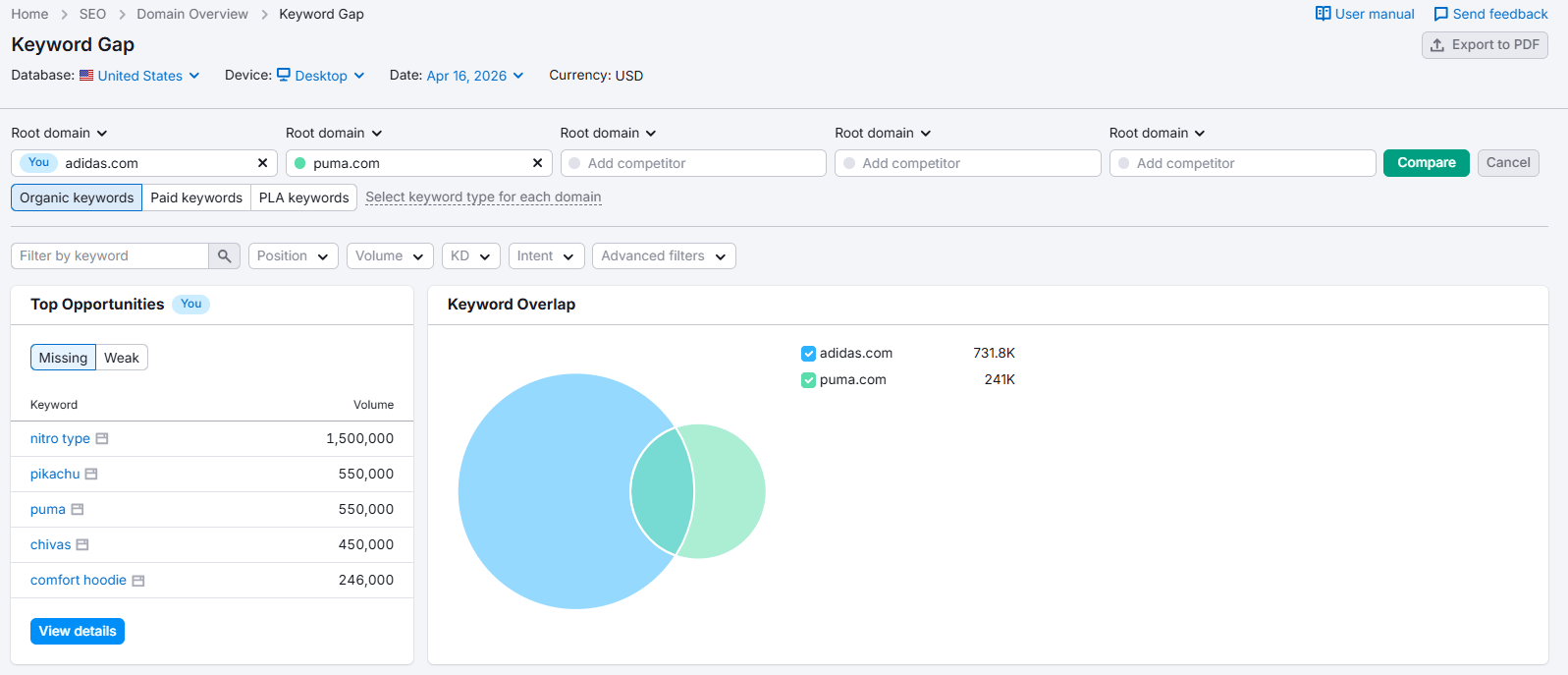
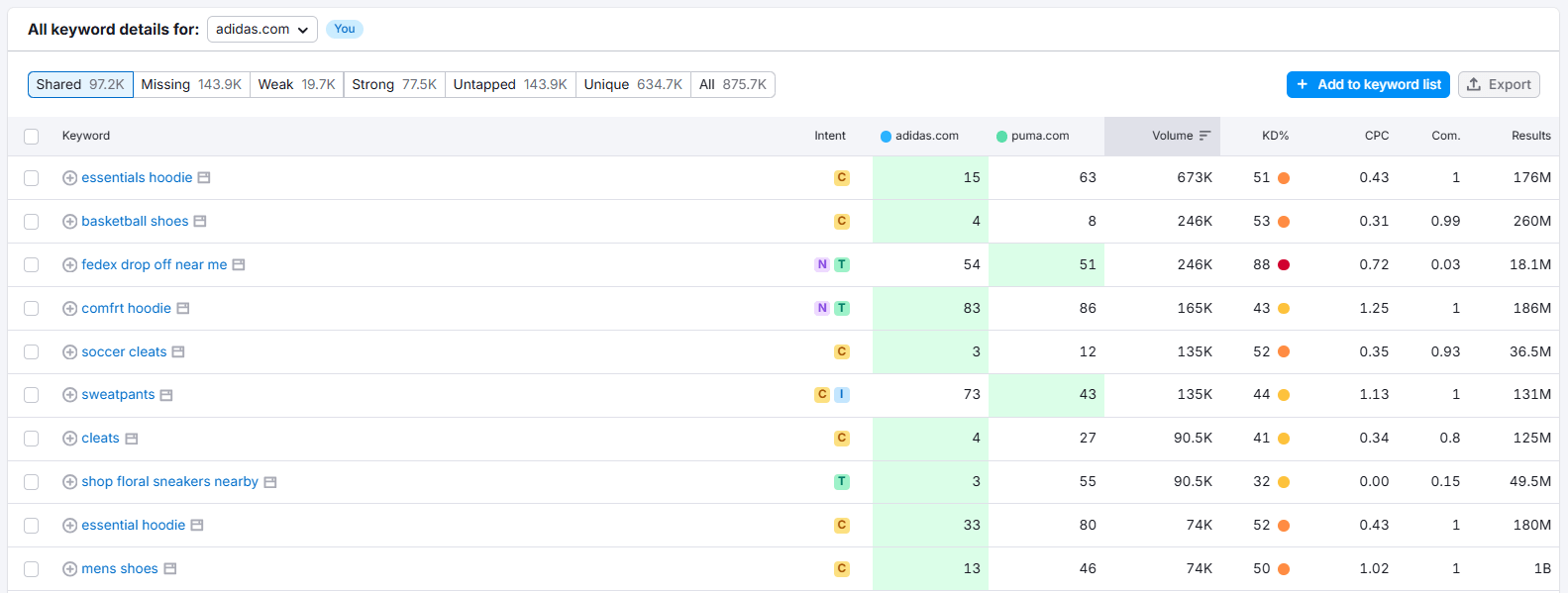
Semrush Keyword Gap tool
After entering several competing domains, the tool compares ranking keywords across all sites. This makes it easy to identify terms where competitors appear in search results but your website does not.
Typical insights revealed by this analysis include:
- keywords multiple competitors rank for
- queries driving traffic to competing pages
- opportunities where ranking difficulty appears moderate
Because the tool compares several domains at once, patterns begin to emerge quickly. If three or four competing websites all rank for the same keyword cluster, it is often a strong signal that the topic deserves attention.
Ahrefs provides a very similar workflow through its Content Gap feature inside Site Explorer.
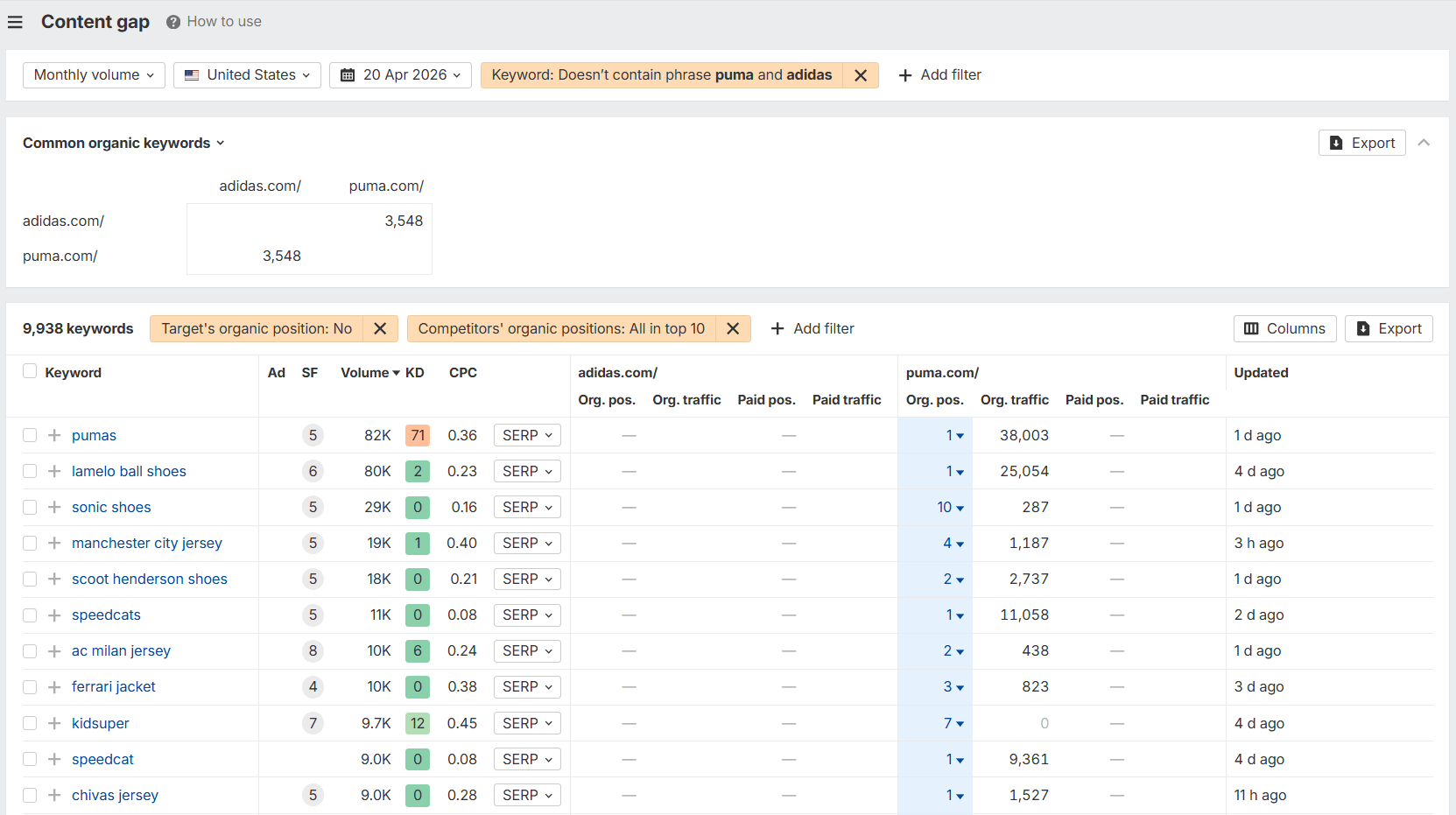
Ahrefs Content Gap Analysis Report
Once competitor domains are added, Ahrefs generates a list of keywords that those websites rank for while your site does not. The report also shows which competitors rank for each keyword and how strong the ranking pages appear to be.
Many SEO professionals rely on this report early in the research phase of a project because it quickly reveals topics competitors have already validated with search traffic.
Identifying Traffic Driving Pages
Another valuable research method involves identifying which pages generate the most organic traffic for competing websites.
Rather than starting with keywords, this approach focuses on high performing content.
Ahrefs makes this analysis particularly straightforward through the Top Pages report.
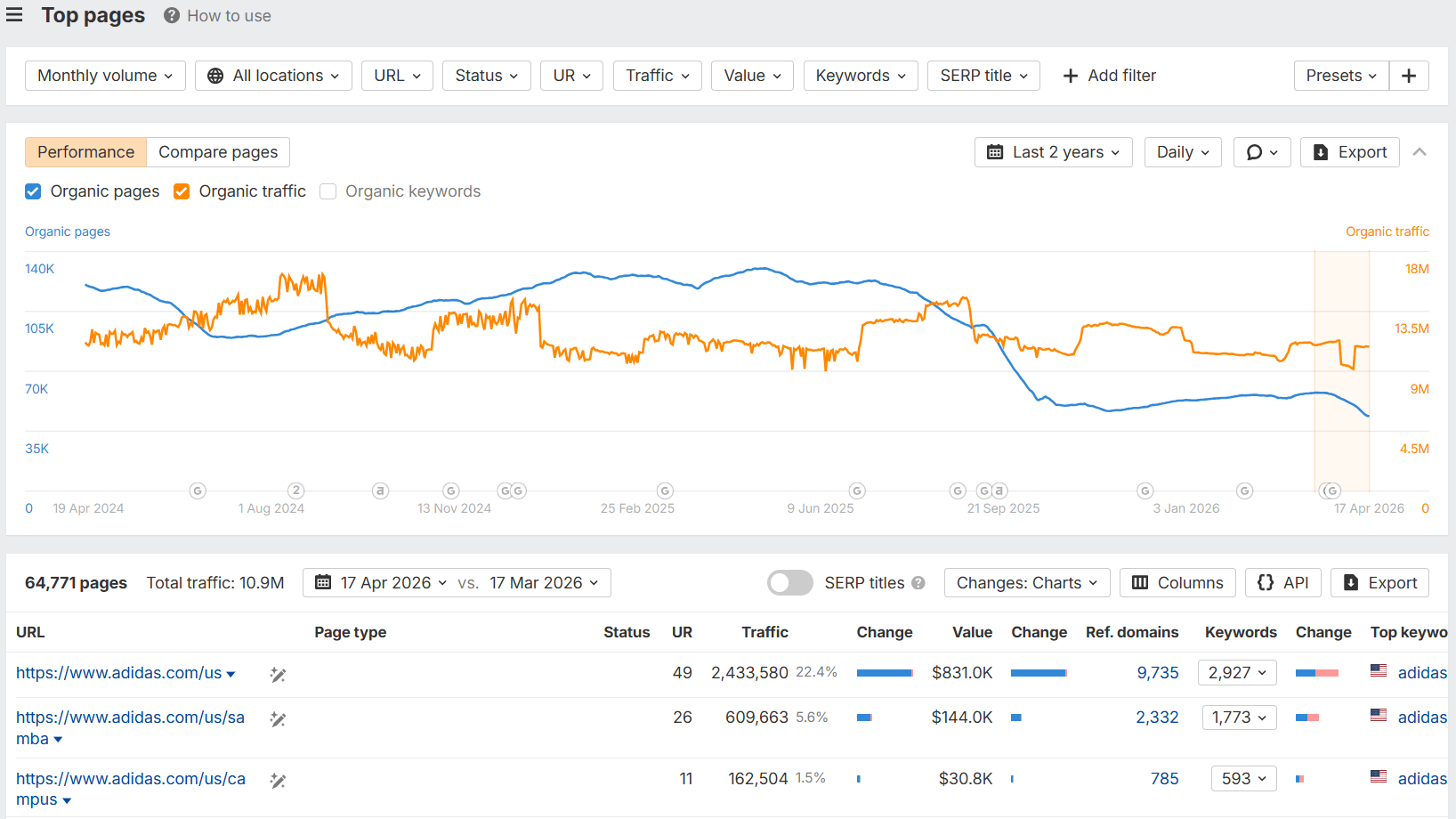
Ahrefs Top Pages Report
This report highlights the pages that generate the most traffic for a given domain. From there, you can explore the keywords each page ranks for and the estimated traffic those rankings produce.
Looking at these pages side by side with your own content often reveals gaps in topic coverage or depth.
Using SEO Tools to Plan Content Clusters
Once you understand what competitors are ranking for, the next step is organizing those insights into a content structure.
Semrush has invested heavily in features designed for this stage of the workflow.
This tool groups related keywords into clusters that can be turned into pillar pages and supporting articles. Instead of targeting individual keywords randomly, the clusters help structure content around broader topics.
A typical workflow might look like this:
- start with a core topic
- generate a large keyword set
- allow the tool to group related queries
- map clusters to future content pieces
Ahrefs does not automate clustering in the same way, but its research reports often reveal similar structures organically. By studying top ranking pages and their keyword footprints, you can see how successful sites organize content around specific topics.
Many SEO professionals combine both approaches: using Ahrefs to understand what content performs best in a niche and then organizing that information into topic clusters during the planning stage.
Semrush vs Ahrefs Pricing
Pricing is one of the areas where the difference between Semrush and Ahrefs becomes particularly relevant, especially for independent website owners and smaller teams.
Both tools position themselves as professional SEO platforms rather than entry level solutions. As a result, the cost reflects the scale of the data infrastructure behind them. Large keyword databases, continuous web crawling, backlink indexing, and SERP monitoring require substantial computing resources.
While the base pricing of the two platforms appears similar at first glance, the real value often depends on how you plan to use the tool and how many projects you manage at the same time.
Semrush SEO Classic Pricing Overview
| Plan | Best For | Monthly | Yearly (Avg) | Key Features |
|---|---|---|---|---|
| Pro | Beginners & individuals | $139.95 per month | $117.33 billed yearly |
|
| Guru | Growing businesses | $249.95 per month | $208.33 billed yearly |
|
| Business | Agencies & large teams | $499.95 per month | $416.66 billed yearly |
|
Ahrefs Pricing Overview
| Plan | Monthly | Yearly | Projects | Tracked Keywords | Best For | Key Features |
|---|---|---|---|---|---|---|
| Lite | $129 per month | $108 $1,290/year | 5 | 750 | Beginners & small sites |
|
| Standard | $249 per month | $208 $2,490/year | 20 | 2,000 | Freelancers & consultants |
|
| Advanced | $449 per month | $374 $4,490/year | 50 | 5,000 | Agencies & in-house teams |
|
Which Tool Offers Better Value
Determining which platform offers better value depends less on the base price and more on how you use the tools in your daily workflow.
Semrush often delivers stronger value for users who want multiple marketing capabilities in a single environment. Because the platform integrates keyword research, technical audits, competitor analysis, and advertising insights, it can effectively replace several separate tools.
Ahrefs, on the other hand, tends to appeal to users who prioritize search intelligence and backlink analysis above everything else. Its data is highly focused on organic search performance, and many professionals appreciate the clarity of its reports.
In practical terms, the decision often comes down to which research workflow feels more natural:
- users who rely heavily on competitor backlink research frequently lean toward Ahrefs
- users who want a broader marketing intelligence platform often prefer Semrush
For many SEO professionals, the most effective approach is to experiment with both platforms and determine which one aligns best with the way they research keywords, competitors, and content opportunities.
Learn everything inside our Complete Semrush review before deciding if it’s the right SEO tool for your workflow
Explore our Ahrefs review and feature breakdown to compare features, pricing, and real-world performance
Semrush vs Ahrefs Pros and Cons
After examining keyword research, backlink analysis, competitor intelligence, and pricing, the decision between Semrush and Ahrefs becomes less about individual features and more about how each platform fits into your research workflow.
Both tools are mature SEO platforms used by agencies, in house marketing teams, and independent website owners. Each can support a full SEO strategy from keyword discovery to competitor analysis and technical audits.
The practical differences appear once you begin working inside the platforms daily. Semrush tends to operate as a broader marketing intelligence suite, while Ahrefs focuses more tightly on search data and link analysis.
Understanding the advantages and limitations of each platform helps clarify which environment will feel more efficient over time.
Advantages of Semrush
One of the defining strengths of Semrush is the breadth of its ecosystem. Instead of functioning only as an SEO research tool, the platform integrates multiple marketing disciplines into a single interface.
The SEO toolkit alone covers keyword discovery, backlink analysis, competitor research, and technical audits. On top of that, Semrush also includes advertising research, content optimization tools, and brand monitoring features.
Several practical advantages become noticeable during regular use.
First, Semrush provides extremely strong keyword discovery capabilities. Tools such as Keyword Magic Tool and Keyword Strategy Builder allow users to expand a single seed keyword into thousands of related queries and organize them into topic clusters.
Second, the technical SEO functionality is particularly robust. The Site Audit tool can crawl large websites, identify issues affecting search performance, and categorize them by severity so they can be prioritized efficiently.
Third, Semrush integrates multiple types of competitive intelligence in one environment. Moving from domain analysis to keyword research and then into backlink evaluation requires very little navigation between tools.
Some of the areas where Semrush consistently performs well include:
- large scale keyword discovery and topic expansion
- detailed technical SEO auditing
- integrated competitor research across multiple tools
- additional marketing insights such as advertising and PPC data
For users who want a single platform capable of supporting several areas of digital marketing, this broader ecosystem can be a significant advantage.
Start your 14-day free trial — no commitment
Advantages of Ahrefs
Ahrefs has built its reputation around search intelligence, particularly in the areas of backlink analysis and competitor research.
The platform operates one of the most active SEO web crawlers, allowing it to discover backlinks quickly and maintain detailed link indexes. As a result, Ahrefs is frequently used when analyzing the link profiles of competing websites or investigating which pages attract natural backlinks.
Another notable strength is the clarity of Ahrefs’ reporting interface. Tools such as Site Explorer, Top Pages, and Referring Domains present complex search data in a format that is easy to interpret.
This makes it particularly effective for reverse engineering competitor strategies. By analyzing which pages generate the most organic traffic for a competing domain, it becomes easier to understand which topics and keyword clusters are driving visibility.
Several aspects of the platform stand out during daily research workflows:
- highly detailed backlink analysis and link history
- clear presentation of organic search data
- strong competitor content research tools
- efficient workflows for investigating ranking pages
For SEO professionals focused primarily on organic search analysis, this streamlined structure often makes Ahrefs extremely efficient to use.
Limitations of Each Platform
Despite their capabilities, both platforms have areas where they may feel less optimal depending on the user’s priorities.
- Semrush
- Includes a very large collection of tools across multiple marketing disciplines
- The interface can initially feel complex and overwhelming
- New users may need time to understand how different tools connect and function together
- Ahrefs
- More focused, with a narrower overall scope
- Strong emphasis on SEO research and backlink intelligence
- Offers fewer integrated features for advertising research or broader digital marketing analysis
In practical terms, these limitations rarely prevent either platform from handling core SEO tasks effectively. The decision usually comes down to which tool aligns better with the type of analysis you perform most often.
Final Verdict: Semrush vs Ahrefs
After comparing keyword research capabilities, backlink analysis, competitor intelligence, and pricing, it becomes clear that both Semrush and Ahrefs are among the most capable SEO platforms available today.
The decision rarely comes down to which tool is objectively better. Instead, the choice usually reflects the type of SEO workflow you rely on most.
Semrush stands out as a broader marketing intelligence platform. Its ecosystem combines keyword discovery, technical SEO audits, competitive research, advertising intelligence, and content planning tools within a single environment. For users who want one platform supporting multiple aspects of digital marketing, this integrated approach can be extremely efficient.
Ahrefs, by contrast, focuses heavily on search intelligence. Its backlink database, competitor research tools, and clean reporting interface make it particularly effective when analyzing ranking pages, evaluating link profiles, and understanding why competing websites perform well in search results.
In practical terms, the decision often looks like this.
Semrush tends to be the stronger choice when your workflow revolves around:
- large scale keyword discovery
- topic clustering and content planning
- technical SEO auditing
- integrated marketing intelligence
Ahrefs is often preferred when your research focuses on:
- backlink analysis and link building research
- competitor content investigation
- analyzing ranking pages and SERP patterns
- quickly reverse engineering successful websites
Both tools are capable of supporting a complete SEO strategy. The most productive platform is usually the one that aligns most naturally with the way you conduct research and plan content.
Industry Adoption and Social Proof
Both Semrush and Ahrefs are widely used across the SEO industry, from solo site builders to full scale marketing teams.
These tools are not just theoretical platforms. They are used daily to make decisions about content, keywords, and competitor strategies.
For example, marketing teams working with platforms like HubSpot often rely on SEO data to support inbound strategies, while ecommerce businesses running on Shopify use keyword and competitor insights to guide product and content visibility.
Beyond direct usage, one of the clearest signals of trust comes from large scale review platforms where real users share their experience.
| Platform | Semrush | Ahrefs | What It Reflects |
|---|---|---|---|
| G2 | ⭐ 4.5+ with thousands of reviews | ⭐ 4.5+ highly rated | Verified user feedback at scale |
| Capterra | 👍 Strong usability scores | 👍 Very positive overall | Ease of use and feature depth |
| Trustpilot | ⚖️ Mixed but improving | ⚖️ Mixed but stable | Broader public sentiment |
| GetApp | ⭐ Consistently well rated | ⭐ Consistently well rated | SMB and real business usage |
Semrush vs Ahrefs: Frequently Asked Questions
These are some of the most common questions readers ask when comparing Semrush and Ahrefs for keyword research, backlinks, beginner usability, and technical SEO.
Semrush often performs very well for large scale keyword discovery because tools like Keyword Magic Tool can generate extensive lists of related keyword variations. This makes it particularly useful when planning content clusters or expanding topical coverage.
Ahrefs also provides strong keyword research capabilities through Keywords Explorer, but its workflow is often more focused on evaluating SERP competition and backlink requirements rather than generating very large keyword sets.
Ahrefs is widely recognized for the scale and depth of its backlink index. The platform operates a large web crawler that continuously discovers new referring domains and updates link data.
Semrush also maintains a very large backlink database and has significantly expanded its crawler in recent years, making the gap between the two platforms much smaller than it was several years ago.
Ahrefs can be a good option for beginners because the interface is relatively straightforward and the reports are easy to interpret. Tools like Site Explorer and Keywords Explorer provide clear insights without requiring complex configuration.
However, the platform is still designed for professional SEO research, so new users may still need time to fully understand the data and metrics presented.
Yes. Semrush includes a dedicated Site Audit tool that crawls websites and identifies issues affecting search visibility. The audit reports categorize problems by severity and provide explanations for common technical SEO issues such as crawl errors, broken links, and page performance problems.
For many users, this functionality allows Semrush to replace separate technical SEO auditing tools.